Most of us are so disconnected from our bodies that we don’t notice tension until it becomes pain. We’re thinking creatures, living in our heads, while our bodies carry stress without acknowledgment. Body scan meditation changes this—systematically moving awareness through the body, discovering what’s there, and often releasing what’s been held.
AI guidance makes this practice more accessible, keeping you on track and offering insight when you get stuck.
What Is Body Scan Meditation?
Body scan meditation involves moving attention slowly through each part of your body:
- Noticing sensations without judgment
- Observing tension, temperature, tingling, numbness—whatever is present
- Often releasing tension simply through awareness
- Developing intimate knowledge of your physical self
It’s one of the foundational practices in Mindfulness-Based Stress Reduction (MBSR) and has decades of research support.
Why Body Scanning Matters
Tension Release
Much tension is held unconsciously. Body scanning brings awareness to these areas, and awareness often allows release:
“You didn’t know your jaw was clenched until you noticed it. Now that you notice, you can let it go. This is the power of body scanning—making the unconscious conscious.”
Stress Detection
Your body often knows you’re stressed before your mind acknowledges it:
“Stomach tight? Shoulders elevated? Breathing shallow? Your body is responding to something. The body scan teaches you to read these signals early, before stress escalates.”
Mind-Body Connection
Many people live dissociated from physical experience:
“For some, the body is just a vehicle for the head. Body scanning reintegrates you—embodied rather than disembodied. This improves everything from emotional regulation to physical performance.”
Pain Management
For those with chronic pain, body scanning offers tools:
“Rather than flinching from pain, we learn to observe it. What shape is it? Does it move? What’s its temperature? This curious examination often reduces suffering, even when sensation remains.”
A Complete Body Scan Practice
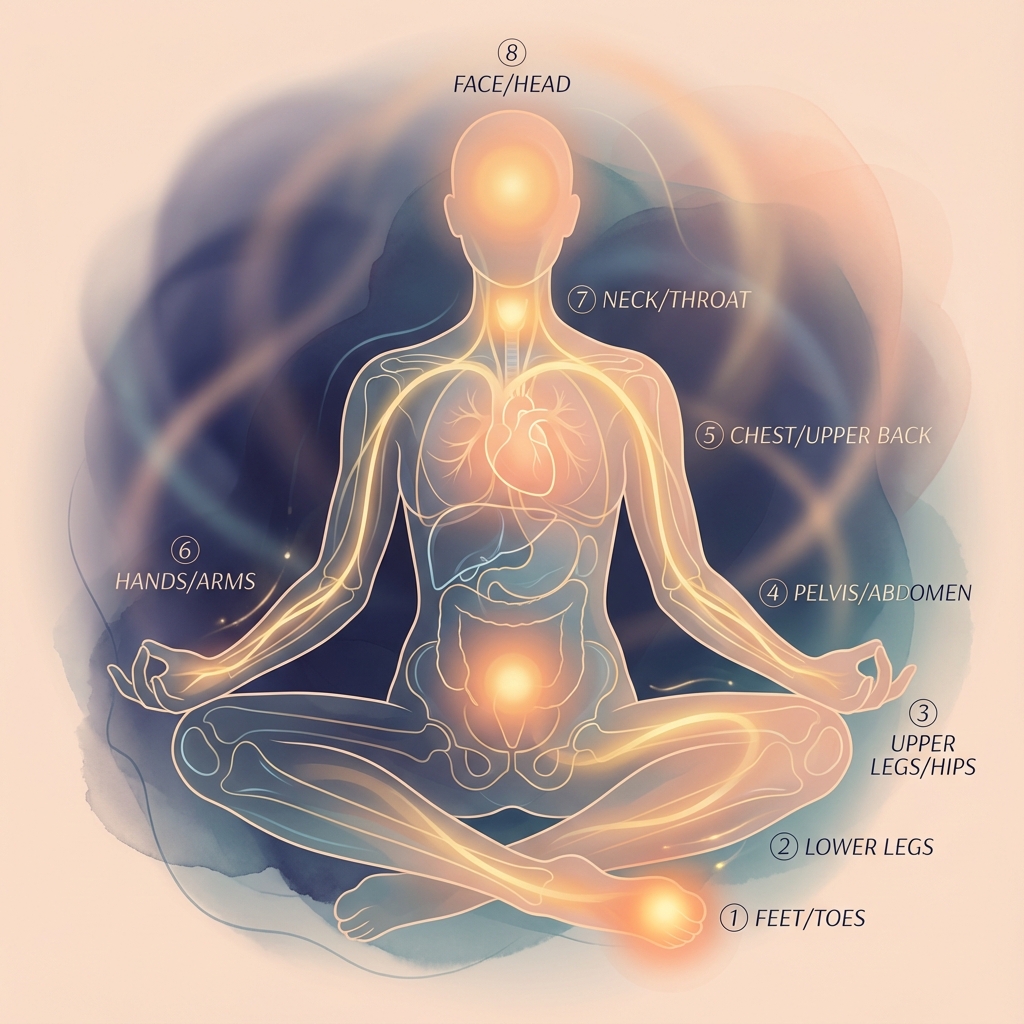
Preparation (2-3 minutes)
Lie down or sit comfortably. Close your eyes. Take a few breaths to arrive.
“We’re going to move through your entire body, from feet to head. Nothing needs to change—we’re just noticing. Whatever you find is okay. This is exploration, not fixing.”
Feet (2 minutes)
“Bring attention to your left foot. Start with the toes—each individual toe. What do you feel? Perhaps tingling, warmth, pressure against fabric. Maybe nothing obvious. Whatever is there, note it.
Now expand to the sole of the foot, the arch, the heel. The top of the foot. The whole left foot as one unit of sensation.
Now the right foot. Same exploration. Toes, sole, arch, heel, top, whole foot.”
Lower Legs (2 minutes)
“Move attention up to the left ankle and lower leg. The shin, the calf muscle. Any tightness? Any ease? Just noticing.
And the right lower leg. Ankle, shin, calf. Exploring with curiosity.”
Upper Legs and Hips (2 minutes)
“The left knee, the thigh. Front, back, sides. The left hip.
And the right side. Knee, thigh, hip. Notice any differences between sides. No need to fix anything—just observing.”
Pelvis and Abdomen (2-3 minutes)
“Move to the pelvis. The sitting bones, the lower back, the pelvis as a whole.
Now the abdomen. This area often holds emotion. What do you find there? Tightness? Churning? Ease? Whatever is present, acknowledge it.”
Chest and Upper Back (2-3 minutes)
“Bring attention to your chest. The heart area. Notice the breath here—the rise and fall. Any constriction? Any openness?
And the upper back, between the shoulder blades. An area that often carries stress. What’s present there?”
Hands and Arms (2 minutes)
“Your left hand. Fingers, palm, back of hand. The wrist, forearm, upper arm, left shoulder.
And the right side. Hand, wrist, forearm, upper arm, shoulder. Notice any differences between sides.”
Neck and Throat (1-2 minutes)
“The neck. Front, back, sides. An area of vulnerability that often holds tension. What do you find?
The throat. Swallowing, voice, emotions—so much passes through here. Just notice.”
Face and Head (2-3 minutes)
“The jaw. A major tension holder for many. Teeth clenched or apart? Jaw pushed forward or relaxed?
The mouth, lips, tongue. Just awareness.
The nose, the sinuses, breathing sensations.
The eyes—even closed, they hold tension. The forehead, often furrowed unconsciously.
The scalp, the very top of the head.
The whole head as one unit.”
Whole Body (2 minutes)
“Now sense the whole body at once. From feet to head, everything connected. One continuous field of sensation. Breathing happening on its own. Body complete, whole, alive.”
Closing (1-2 minutes)
“Gently begin to conclude. Perhaps small movements in fingers and toes. Preparing to return to full activity while carrying this body awareness with you.”
How AI Enhances Body Scanning
Pacing Guidance
Without guidance, attention rushes or drifts. AI provides appropriate pacing for thorough exploration.
Attention Redirection
When the mind wanders (it will), guidance brings you back without judgment.
Language for Sensation
“Is the sensation sharp or dull? Hot or cold? Constant or pulsing? Static or moving?”
AI offers vocabulary for exploring the often hard-to-describe landscape of sensation.
Adaptation
If you mention specific concerns (back pain, anxiety-prone area), AI can spend more time there or offer specific guidance.
Body Scan Variations
Quick Scan (5 minutes)
For time-limited practice:
- Major regions only: feet/legs, torso, arms, head
- Less detail, same concept
- Excellent for midday reset
Sleep Scan
For falling asleep:
- Start from head and move down (different from standard order)
- Very slow pacing
- Permission to drift off mid-scan
Pain-Focused Scan
For chronic pain:
- More time on pain areas
- Exploratory rather than reactive stance
- Often reduces suffering though sensation remains
Tension-Release Scan
Adding intentional release:
- Identify tension areas
- With each exhale, imagine tension flowing out
- Active release rather than pure observation
Common Experiences and Questions
“I Don’t Feel Anything”
Numbness or absence of sensation is what’s there. That’s valid data. With practice, sensitivity increases.
“My Mind Wanders Constantly”
Expected and normal. The practice is noticing the wandering and returning. Each return builds attention muscle.
“I Fall Asleep”
If you’re using it for sleep, perfect. If not, try sitting up or practicing at a different time. But if your body needs sleep, maybe trust that.
“Some Areas Are Uncomfortable”
You can stay with discomfort while exploring it, or move on and return later. You’re in control.
“I Feel Emotions During the Scan”
Certain body areas hold emotional content. Stomach, chest, and throat especially. The scan can surface what’s been stored. This is often healing, though sometimes intense.
Benefits of Regular Practice
People who practice body scanning regularly report:
- Reduced chronic tension
- Earlier detection of stress
- Better pain management
- Improved body image (through accurate rather than critical perception)
- Better emotional regulation
- Improved sleep
- Enhanced athletic performance
- Greater overall presence
The body scan builds a skill—body awareness—that transfers to all of life.
Building a Body Scan Practice
Daily Practice
Even 10 minutes daily builds body awareness significantly. Bedtime is convenient though any time works.
Response to Stress
When you notice stress, a brief scan identifies where it’s held physically, allowing targeted release.
Physical Activity Pairing
Before or after exercise, body scanning increases performance and recovery.
Frequently Asked Questions
How long should a body scan take?
Full practice: 20-45 minutes. Quick version: 5-10 minutes. Both are valuable.
Should I try to relax during the scan?
Relaxation often happens, but it’s not the goal. The goal is awareness. Whatever you find—tension or ease—is valid.
Can I body scan sitting up?
Yes. Lying down often works best for depth, but seated scans are perfectly effective and reduce sleep risk.
What if I find something concerning?
Body awareness can reveal tension or sensation that prompts seeing a doctor. This is a feature, not a bug—early detection is valuable.
How is this different from progressive muscle relaxation?
PMR deliberately tenses then releases muscles. Body scanning simply observes without intervention. Both reduce tension but through different mechanisms.
The Bottom Line
Your body is always communicating. Body scan meditation teaches you to listen. Through systematic attention to physical sensation, you discover hidden tension, develop early stress detection, and build a deeper relationship with your physical self. AI guidance keeps you on track, offers language for sensation, and adapts to your needs. The body you’ve been ignoring has much to tell you—if you’re willing to listen.