You’ve done the physical training. You’ve built the strength, the speed, the skills. But when the competition arrives, something happens—nerves take over, old patterns emerge, and you perform below what you know you’re capable of. This is the mental game, and it’s where AI hypnosis becomes a powerful training tool.
Sports psychology has used hypnosis for decades. Now, AI-guided hypnosis makes these techniques accessible to athletes at every level, not just those with access to expensive specialists.
The Mental Game in Sports
Physical preparation is only part of athletic performance:
- Focus: Concentrating fully, eliminating distraction
- Confidence: Trusting your training when pressure mounts
- Composure: Staying calm when stakes are high
- Recovery: Bouncing back from mistakes mid-competition
- Visualisation: Mental rehearsal that improves physical performance
- Pain tolerance: Managing discomfort without losing performance
Elite athletes have known for years: training the mind is as important as training the body.
How AI Hypnosis Helps Athletes
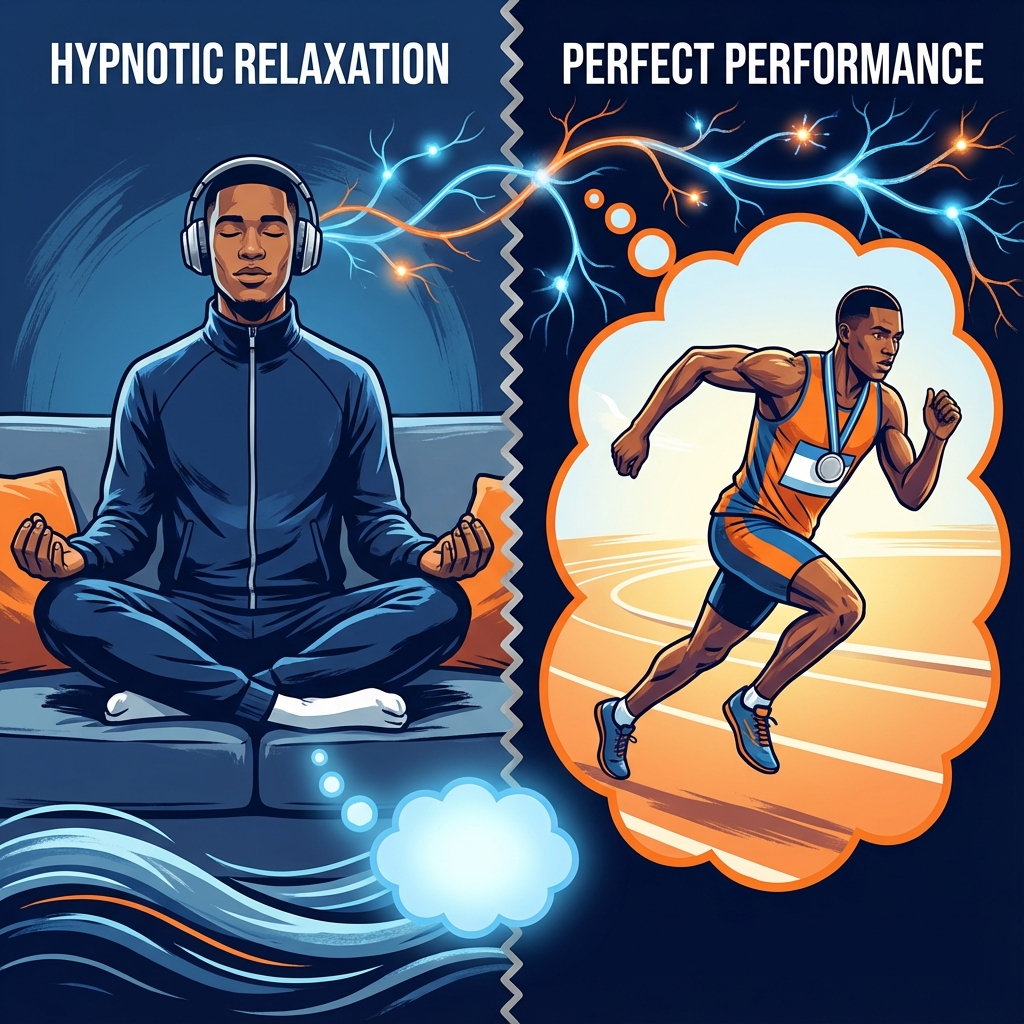
Performance Visualisation
Mental rehearsal improves actual performance—this is established science:
“See yourself at the starting line. Feel your body—trained, ready, powerful. The signal comes. Watch yourself execute perfectly—each movement smooth, each moment exactly as you’ve trained. Your body knows this. Your mind is confirming it.”
Research shows that visualising actions activates similar brain regions to actually performing them. AI-guided visualisation provides structured, effective mental practice.
Competition Anxiety Management
Pre-competition nerves can help or hurt:
“Adrenaline is fuel, not an enemy. These sensations—the heightened alertness, the activation—your body is preparing to perform. Transform anxiety into excitement. The energy is the same; only your interpretation differs.”
AI hypnosis helps reframe anxiety as activation, calming excess while preserving useful energy.
Focus Enhancement
Concentration under pressure is trainable:
“Nothing exists except this moment, this action. The crowd? Not here. Past mistakes? Gone. Future outcomes? Not yet. Just now. Just this. Your attention belongs only to the task in front of you.”
Recovery from Mistakes
Bad plays happen; spiraling after them is optional:
“That mistake happened. It’s data, not destiny. Release it now. The next play is unrelated to the last. Fresh attention, fresh execution. You know how to do this. Do it.”
Pain and Discomfort Management
Endurance sports often involve pain:
“Pain is information, not a command. You can acknowledge discomfort while choosing to continue. Your body is stronger than the sensation suggests. Breathe into it. Move through it.”
(Note: This is for normal training/competition discomfort, not injury warning signals.)
Sport-Specific Applications
Endurance Sports (Running, Cycling, Swimming)
“Mile by mile. Stroke by stroke. Your body finds rhythm. Pain rises and falls—but you continue. This is what you trained for. You can do hard things.”
Focus areas: Pacing, pain management, maintaining focus over long duration
Power Sports (Weightlifting, Throwing, Sprinting)
“Explosive power lives in you. At the moment of execution, everything channels into this single action. Collected, then released. Maximum force, perfect timing.”
Focus areas: Pre-lift focus, explosive power access, technical precision
Skill Sports (Golf, Tennis, Archery)
“Quiet mind, trained body. Your conscious thinking steps aside—you’ve practiced enough. Trust the swing. Trust the stroke. Let execution happen.”
Focus areas: Elimination of overthinking, trusting muscle memory, consistency
Team Sports (Football, Basketball, Soccer)
“You’re part of a unit, yet individually responsible. See the field. Sense your teammates. Make decisions fluidly. Individual excellence in service of collective success.”
Focus areas: Reading play, quick decision-making, managing team dynamics
Combat Sports (Boxing, Wrestling, MMA)
“Calm in chaos. Your opponent is aggressive—but you’re reading, timing, choosing moments. Controlled aggression. Patient ferocity.”
Focus areas: Managing intensity, reading opponent, controlling fear
Building an Athletic Hypnosis Practice
Pre-Season: Foundation
- General mental skills development
- Confidence building
- Visualisation of season goals
- 15-20 minute sessions, 3-4 times per week
In-Season: Maintenance and Preparation
- Pre-competition sessions (evening before or morning of)
- Post-competition recovery
- Addressing specific challenges as they arise
- Shorter sessions (10-15 minutes)
Competition Day: Focused Preparation
- Morning visualisation of optimal performance
- Pre-event centering (5-10 minutes before)
- Brief reset between events/rounds if applicable
Recovery: Physical and Mental
- Post-training sessions to enhance recovery
- Processing competitions (learning, not ruminating)
- Managing fatigue and motivation
Sample Pre-Competition Session
Centering (2 min) “Arrive in the present. Yesterday’s training is done. Tomorrow’s results don’t exist yet. There is only now, and you are ready.”
Body Preparation (3 min) “Feel your body. It’s trained, capable, prepared. Every session has built toward this. Trust what you’ve built.”
Performance Visualisation (5 min) “See yourself competing. Not generically—specifically. The movements, the feelings, the execution. You’re doing this now, in your mind. Your brain is laying tracks your body will follow.”
Focus Anchoring (2 min) “Create an anchor—perhaps touching thumb to finger. When activated, this brings instant focus. Practice the anchor now. Feel that centered clarity. It’s available on demand.”
Activation (2 min) “Energy rises. Not anxiety—readiness. You’re about to compete, and you’re ready. Feel that rising power. Come back to the present, alert and prepared.”
Common Athletic Mental Challenges
Performance Anxiety
“The situation matters to you—of course you feel something. This energy serves you. Let it flow into performance rather than resistance.”
Choking Under Pressure
“You’ve done this in practice countless times. Competition is just practice with witnesses. The skill is the same. Execute what you know.”
Comeback After Injury
“Your body has healed. Trust that healing. Move confidently, not cautiously—the opposite of what injury taught. You are whole again.”
Plateau and Motivation
“Every champion has faced what feels like flat progress. This is consolidation, not stagnation. Continue the work. Breakthrough is coming.”
Pre-Competition Insomnia
“Thoughts of tomorrow won’t change it. Rest is part of preparation. Let tomorrow wait. For now, only sleep matters.”
The Science Behind Athletic Hypnosis
Research supports hypnosis for sport performance:
- Motor imagery: Visualising movement activates motor cortex
- Anxiety reduction: Hypnosis reduces pre-competition cortisol
- Pain tolerance: Hypnosis can increase discomfort tolerance
- Focus: Hypnosis training improves attentional control
- Recovery: Hypnosis may enhance physical recovery through stress reduction
This isn’t fringe practice—it’s mainstream among elite athletes.
Famous Athletes Who Use Mental Training
- Michael Phelps: Visualisation was central to his training
- Tiger Woods: Worked with a psychologist using hypnosis techniques
- Kobe Bryant: Known for intense mental preparation
- Many Olympic programs include formal mental skills training
The elite know: physical and mental training are partners.
Frequently Asked Questions
Is hypnosis legal in sport?
Yes. Mental training is not prohibited by any sports governing body.
How quickly will I see results?
Many athletes report immediate benefits from visualisation and anxiety management. Deeper changes develop over weeks of consistent practice.
Should I use this instead of a sports psychologist?
AI hypnosis is excellent for regular practice and accessible mental training. For complex issues (trauma, severe anxiety, career transitions), a human sports psychologist adds value.
Can hypnosis replace physical training?
No. Hypnosis enhances performance by optimising mental state. It works alongside physical training, not instead of it.
What if my coach thinks this is weird?
Mental training is increasingly mainstream in sport. But even if your coach is skeptical, your mental practice is your business. Many athletes train mentally without announcing it.
The Bottom Line
Your body is trained. The question is whether your mind shows up to let that training express fully. AI hypnosis offers the mental training tools that elite athletes have accessed for years—now available to any athlete, at any level, through your phone. The physical work is necessary; the mental work makes it count.