Worry feels productive. Your brain tells you that if you just think through every possible problem, you’ll be prepared. But chronic worry doesn’t solve problems—it just steals your present moment and leaves you exhausted.
If you spend hours each day caught in “what if” spirals, jumping from one worry to the next, struggling to relax even when you want to, AI hypnosis might offer the pattern interrupt you’ve been looking for.
Understanding Chronic Worry
Occasional worry is normal. Chronic worry is different:
- It’s persistent: You worry most days, about multiple topics
- It’s hard to control: You can’t “just stop” no matter how much you want to
- It jumps around: Fix one worry and another immediately takes its place
- It feels necessary: Part of you believes worrying prevents bad things
- It’s physically exhausting: Your body carries constant tension
Chronic worry often indicates Generalised Anxiety Disorder (GAD), which affects about 6% of people at some point in their lives. Whether or not you meet clinical criteria, AI hypnosis offers tools to interrupt the pattern.
Why Worry Is So Hard to Stop
Your brain has learned that worrying = safety. On some level, you believe that if you anticipate problems, you can prevent them. This was useful when our ancestors faced physical threats—anticipating danger helped them survive.
But modern worries rarely require physical action. You can’t outrun a financial concern or fight a relationship worry. Yet your brain treats these abstract threats as if they’re physical, keeping your nervous system in a constant state of alert.
The challenge is that you can’t think your way out of worry. The harder you try to stop worrying, the more you worry about worrying. This is why hypnosis is effective—it works with the subconscious where worry patterns live.
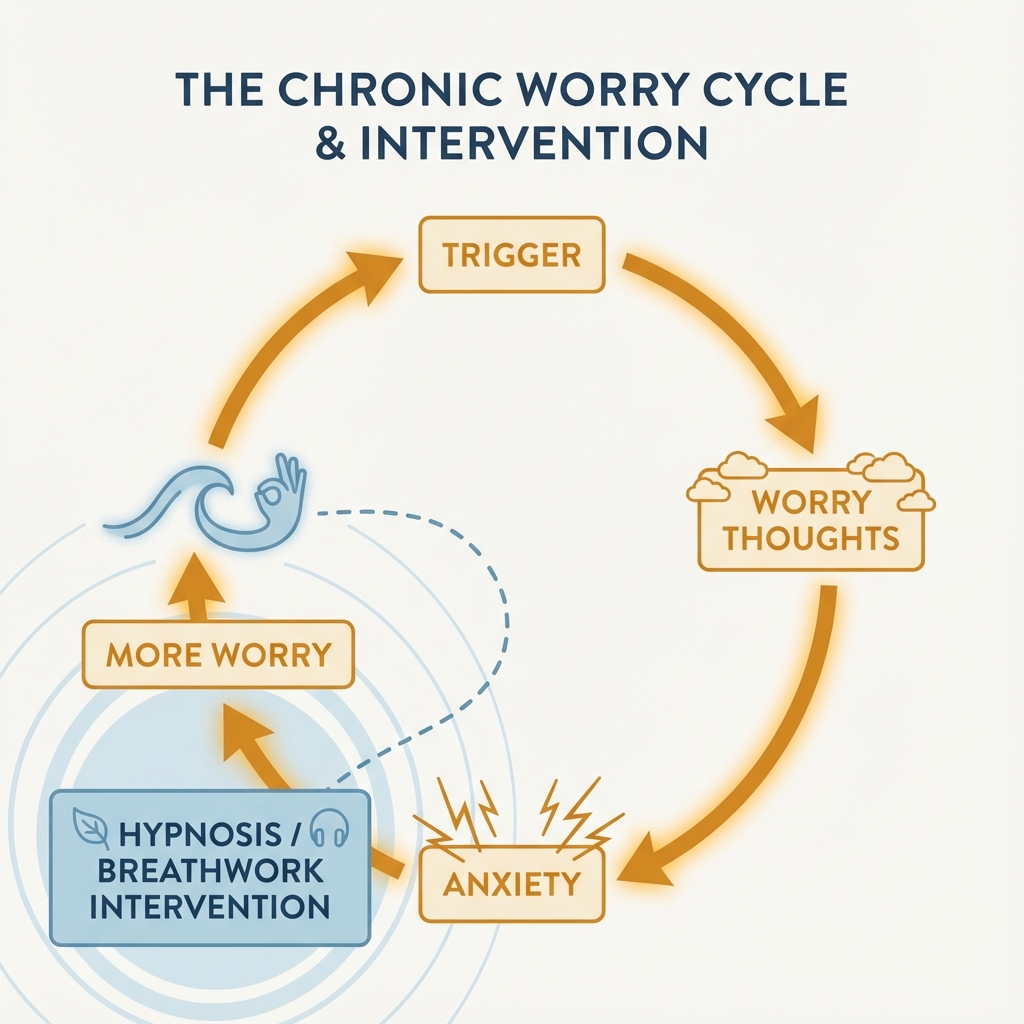
How AI Hypnosis Interrupts Chronic Worry
Accessing the Subconscious
Worry patterns run on autopilot. By the time you consciously notice you’re worrying, you’re already deep in the spiral. Hypnosis speaks directly to the subconscious mind, where these automatic patterns can be modified at their source.
Installing Calm as the Default
Through repeated sessions, AI hypnosis helps establish calm as your baseline state rather than worry. Instead of relaxation being something you have to actively create, it becomes your starting point, with worry requiring effort to activate.
Building Mental Pattern Interrupts
AI hypnosis installs triggers that help you notice and interrupt worry before it escalates:
“Each time a worry begins to form, you’ll notice a slight signal—maybe a tightening in your jaw or chest. This signal becomes your cue. Not to fight the worry, but to gently acknowledge it: ‘There’s that worry habit again.’ And with that acknowledgment, it begins to dissolve.”
Rewriting the “Worry = Safety” Belief
Deep hypnotic work can address the core belief that underlies chronic worry:
“Your subconscious has been trying to protect you through worry. We thank it for that effort. But now, we’re updating that old program. Safety comes from presence, from wise action when needed, from trusting yourself to handle whatever arises—not from anticipating every possible problem.”
Techniques for Chronic Worry
The Worry Container
“Imagine a sturdy container with a secure lid. It can be any style—wooden chest, steel safe, ornate box. This is where your worries go when you’re ready to set them down. You’re not throwing them away—they’ll be there if you truly need to retrieve them. But for now, you can set them inside through a small slot in the top, and gently close the lid.”
The Future Self Meeting
“Travel forward in your mind to meet yourself one year from now. This future you has lived through the next year, including all the things you’re currently worrying about. Ask them: ‘How did it turn out?’ Listen to their answer. Notice how many of the worries you hold now won’t even be remembered by your future self.”
The Worry Audit
“Run through your current worries. For each one, ask: Is this something I can take action on today? If yes, file it under ‘Action Items.’ If no, file it under ‘Not My Problem Right Now.’ Most worries belong in the second category.”
The 3-Minute Release
“For just three minutes, we’re going to practice complete surrender. You cannot fix anything in these three minutes. You cannot prevent anything in these three minutes. So for these three minutes, you’re off duty. Your only task is to breathe and let the worrying muscle rest.”
Building a Worry-Resistant Mind
Daily Practice
Consistent AI hypnosis rewires your brain’s default patterns. Even 10-15 minutes daily creates cumulative changes:
- Week 1-2: Temporary relief during and after sessions
- Week 3-4: Beginning to notice worries faster, interrupting them easier
- Month 2+: Baseline anxiety lower, worry spirals shorter and less frequent
Morning Protection
Starting the day with hypnosis before worry has a chance to establish itself:
“As you move through today, you carry a gentle calm with you. Concerns will arise—that’s natural. But they won’t be able to hook you the way they used to. You’ll notice them, consider if action is needed, and let them pass.”
Nighttime Release
Worry often peaks before sleep. Evening sessions help:
“The day is done. There is nothing you can accomplish right now through worry. Every concern can wait until tomorrow. For now, your only task is rest.”
Physical Components of Worry
Chronic worry lives in the body as much as the mind:
- Muscle tension: Jaw, shoulders, neck, back
- Digestive issues: The gut-brain connection is powerful
- Fatigue: Worry is exhausting even though you’re “just thinking”
- Sleep problems: Racing mind at night, waking with anxiety
AI hypnosis addresses these physical manifestations through progressive relaxation, body awareness, and nervous system regulation. As worry decreases, physical symptoms often improve.
What Chronic Worriers Need to Know
Worry Isn’t Solving Problems
Your brain tells you that worrying is productive. Track your worries for a week: how many led to useful action? How many just spun in circles? The data usually shows that worry rarely produces solutions—it just consumes energy.
You Won’t “Jinx” Things by Not Worrying
Many chronic worriers have magical thinking: “If I worry about it, it won’t happen.” This isn’t logical, but anxiety isn’t logical. AI hypnosis can address this belief at the subconscious level.
Peaceful Doesn’t Mean Reckless
Reducing worry doesn’t mean ignoring real concerns. You’ll still notice when something needs attention. The difference is that you’ll respond from calm rather than react from panic—which actually leads to better decisions.
When to Seek Additional Support
AI hypnosis is valuable for chronic worry, but consider professional help if:
- Worry significantly impairs daily functioning
- You can’t work, sleep, or maintain relationships due to anxiety
- You have panic attacks
- You develop depression alongside worry
- Worry is part of OCD patterns
Cognitive Behavioral Therapy (CBT), particularly the worry-focused variety, works well alongside hypnosis for chronic anxiety.
Getting Started
If chronic worry has been dominating your life:
- Commit to two weeks—Real pattern change takes consistency
- Practice at the same time—Build it into your routine
- Don’t expect instant transformation—Notice small shifts
- Combine practices—Morning + evening works better than random sessions
- Track your worry—Awareness itself reduces worry power
Frequently Asked Questions
If I stop worrying, won’t I miss important things?
Genuine concerns that need action will still register. What stops is the compulsive, unproductive spinning that helps nothing.
How is this different from distracting myself?
Distraction temporarily shifts attention but doesn’t change underlying patterns. Hypnosis rewires the patterns themselves, creating lasting change.
Can I be hypnotised if my mind is always racing?
Yes. The hypnotic process helps calm a racing mind as part of its induction. Many chronic worriers find hypnosis more accessible than meditation precisely because the active guidance gives their busy minds something to follow.
How long until I notice improvement?
Some people feel relief in the first session. Most notice significant pattern changes after 2-4 weeks of consistent practice.
The Bottom Line
Chronic worry feels like it’s protecting you, but it’s actually stealing your life. AI hypnosis offers a way to interrupt these patterns at their source, building a calmer mind that can handle life’s genuine challenges without manufacturing imaginary ones. Your peace is on the other side of consistent practice.