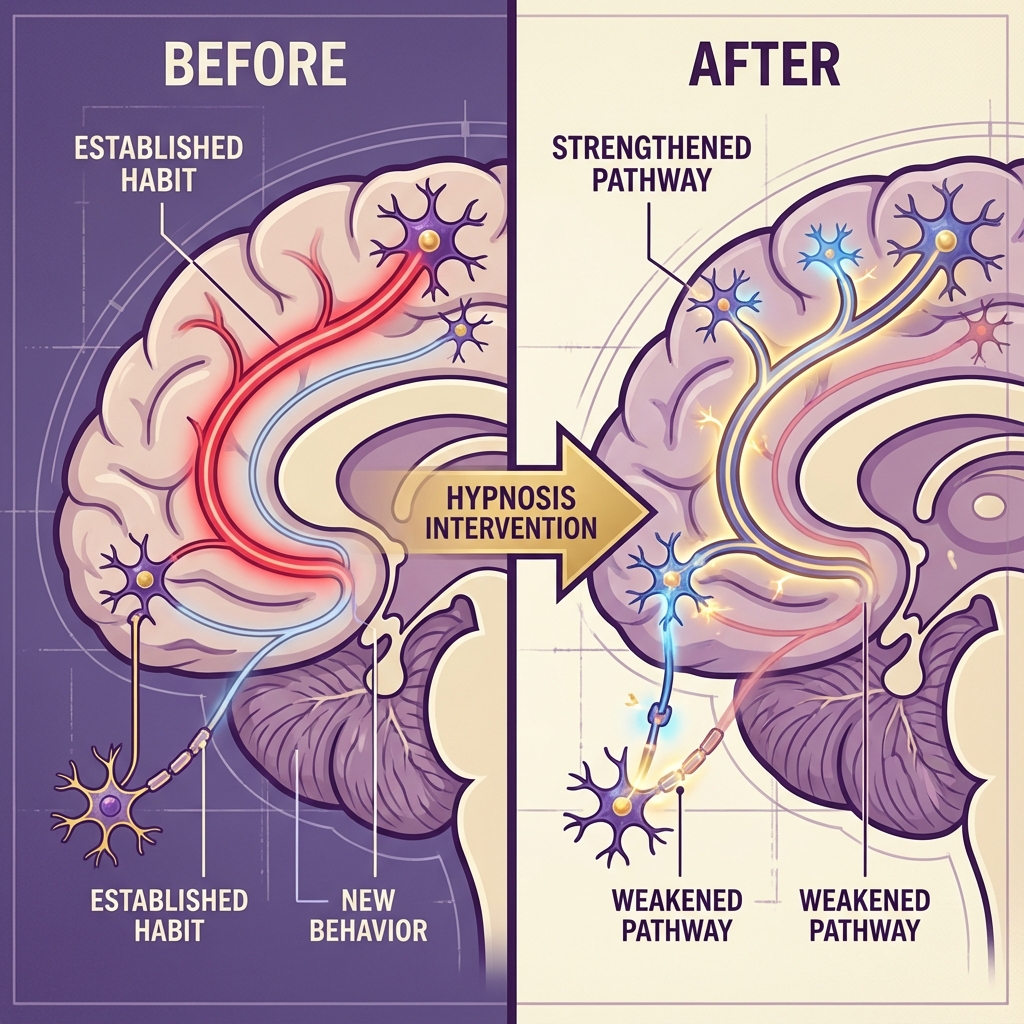
Habits aren’t character flaws or willpower failures—they’re neural pathways. Each time you repeat a behaviour, the pathway strengthens; the action becomes more automatic. This is neuroplasticity: the brain’s ability to rewire itself based on experience. AI hypnosis works with this natural process, accelerating habit change from the inside out.
How Habits Form in the Brain
The Habit Loop
Every habit follows a pattern:
- Cue: A trigger in the environment or internal state
- Routine: The behaviour itself
- Reward: The benefit that reinforces the behaviour
Over time, this loop becomes automatic, shifting from conscious decision to unconscious pattern.
Neural Pathway Strengthening
“Neurons that fire together wire together.” Repeated behaviours create strong, efficient neural connections. That’s why habits feel automatic—they are.
Basal Ganglia Storage
Established habits move from the prefrontal cortex (conscious thinking) to the basal ganglia (automatic processing). This frees up mental energy but makes habits resistant to conscious change.
Why Habits Are Hard to Change
You’re Fighting Automatic Systems
Conscious willpower versus automatic patterns is an unfair fight. Automatic wins in the long run.
The Old Pattern Still Exists
New habits don’t delete old ones—they compete with them. Under stress, the stronger (older) pathway often wins.
Reward Circuits Are Powerful
Habits that provide immediate reward (sugar, scrolling, substances) have strong neurological hooks.
Environment Triggers Persist
The same cues that triggered old behaviour continue triggering it, even when you consciously want something different.
How Hypnosis Changes the Game
Accessing Automatic Systems
“Hypnosis works at the level where habits live—below conscious thought. It speaks to the automatic systems directly.”
Installing New Patterns
“Rather than just inhibiting old behaviour, hypnosis installs new responses. Here’s the cue—here’s what happens instead.”
Strengthening Through Rehearsal
“Mental rehearsal in hypnosis creates neural activity similar to actual behaviour. You’re building the pathway before you act.”
Reducing Unconscious Resistance
“The subconscious may resist conscious decisions for reasons you don’t fully understand. Hypnosis addresses these resistances directly.”
The Neuroplasticity Window
Hypnosis may enhance neuroplasticity directly:
Theta Wave States
Hypnotic relaxation often produces theta brain waves (4-8 Hz)—associated with learning, memory, and neuroplastic change.
Reduced Critical Factor
The “critical factor” that usually rejects new suggestions is relaxed. New patterns can install more easily.
Focused Attention
Concentrated focus activates neuroplastic mechanisms more effectively than divided attention.
Repetition Integration
Repeated hypnotic suggestion might strengthen new pathways more efficiently than behavioural repetition alone.
Building a New Habit with Hypnosis
1. Define the New Habit Clearly
What specifically will you do, when, where, and how? Vague intentions don’t become habits.
2. Identify the Cue
What will trigger the new behaviour? Existing habits, times of day, and environmental cues work well.
3. Create the Mental Movie
In hypnosis, visualise the complete new behaviour: cue → new routine → reward. Make it vivid and specific.
4. Repeat Regularly
Multiple hypnosis sessions strengthen the new pathway. Daily practise for 3-4 weeks builds foundation.
5. Practice in Reality
Hypnosis prepares the ground; you still need real-world practise. But now you have neural support.
6. Manage Setbacks
Old patterns may resurface under stress. This doesn’t mean failure—just continue reinforcing the new.
Breaking an Old Habit with Hypnosis
1. Understand the Reward
What does the old habit give you? Until you address this, change is difficult.
2. Install a Replacement
Don’t just stop the old behaviour—give the brain something else to do at the cue.
3. Weaken Cue-Behaviour Link
In hypnosis, practise noticing the cue without the automatic response following.
4. Build New Reward Associations
Connect the new behaviour to positive feelings. Connect the old behaviour to its true costs.
5. Expect Extinction Bursts
When you stop a behaviour, the urge often intensifies before fading. This is normal.
The Reality of Timeline
Be patient with neural change:
Weeks 1-2
New patterns feel effortful. Old patterns still pull stronger.
Weeks 3-4
New patterns become easier. Automatic activation begins.
Months 2-3
New patterns solidify. Old patterns weaken from disuse.
Long-term
New habits feel natural. But old pathways never fully disappear—they just become dormant.
Frequently Asked Questions
How long until the habit sticks?
Classic “21 days” is too simple. Simple habits form faster; complex ones take longer. Expect 2-3 months for solid establishment.
Can hypnosis really change my brain?
Yes. All experience changes your brain—that’s what learning is. Hypnosis provides focussed, repetitive experience that directs that change.
Will the old habit come back?
Under sufficient stress, old patterns can reactivate. But continued reinforcement of new patterns minimises this.
How often should I practise hypnosis for habit change?
Daily for optimal results, especially during the first month. Can reduce to maintenance frequency after the habit is established.
Does it matter what habit I’m trying to change?
Complexity varies, but the basic neurological principles apply to all habits.
The Bottom Line
Habits aren’t fixed—they’re neural pathways that can be modified. The brain’s neuroplasticity makes change possible at any age. AI hypnosis works with these natural mechanisms, helping install new patterns at the automatic level where habits live. This isn’t magic; it’s applied neuroscience. New pathways form through repetition, mental rehearsal, and focussed attention. Hypnosis provides all three. The old habit wasn’t inevitable; the new one can become just as automatic—with practise.