If you’re exploring meditation apps, you’ve probably noticed a new category emerging: AI meditation. Apps that generate personalised sessions rather than playing pre-recorded content.
The question is: is this actually better? Or is it just a gimmick with worse production quality?
I’ve used traditional meditation apps extensively (primarily Headspace, but also Calm and Insight Timer), and I’ve been using InTheMoment for AI meditation for the past year. Here’s my honest comparison.
How traditional apps work
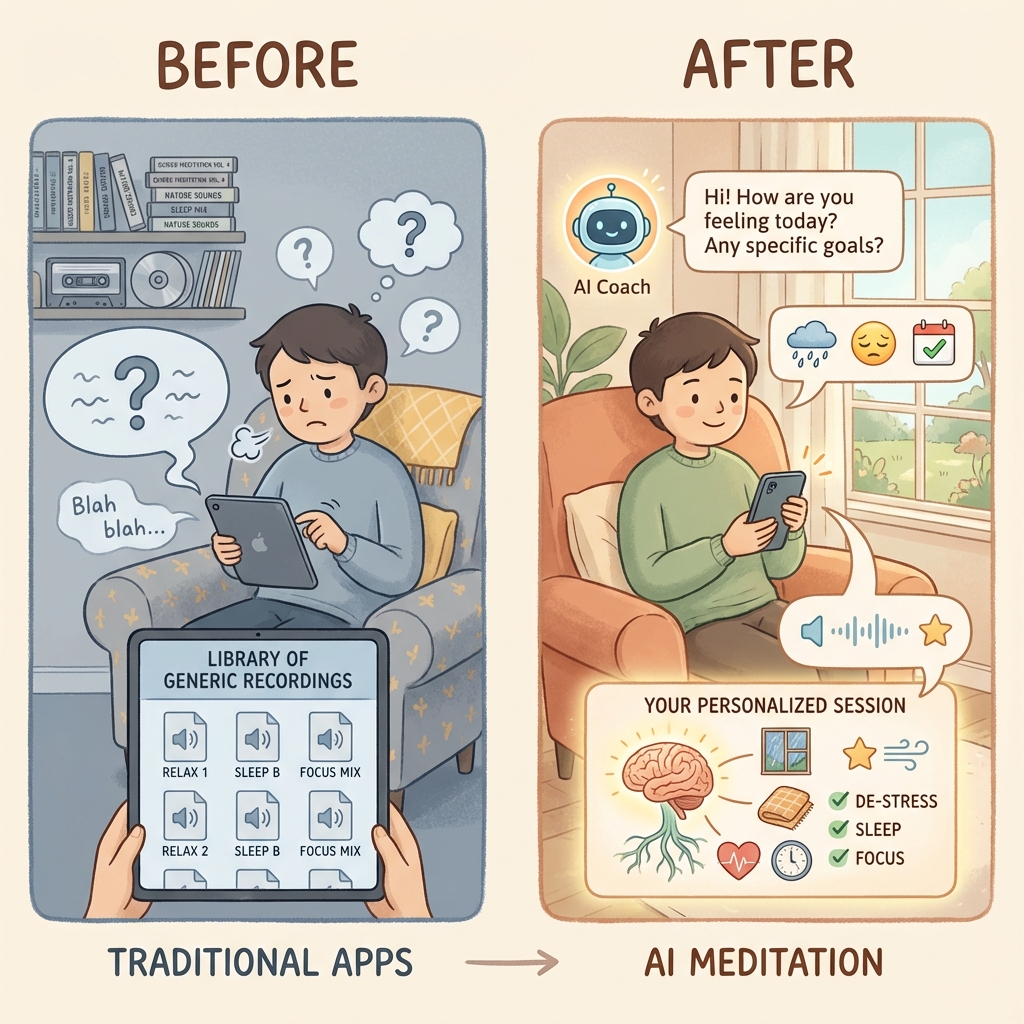
Apps like Headspace and Calm operate on a library model. Expert teachers record meditation sessions on various topics — stress, sleep, focus, anxiety, and so on. These recordings are polished, professionally produced, and backed by meditation expertise.
You browse the library, pick something that sounds relevant, and press play.
The strengths of this approach:
- Genuine expertise. The sessions are created by trained meditation teachers. You’re learning from people who have studied and practised for years.
- High production quality. Professional recording, music, and editing. It sounds polished.
- Curated progressions. Courses are designed to build skills sequentially. Lesson three builds on lessons one and two.
- Proven content. Popular sessions have been used by millions. If they didn’t work, they wouldn’t remain popular.
The weaknesses:
- Generic by necessity. A session recorded for millions of users can’t know anything about you specifically. It addresses common patterns, not your unique situation.
- Limited library. Even thousands of sessions eventually feel repetitive. I found myself outgrowing the library for specific contexts.
- Environment mismatch. Sessions assume you’re in a quiet room with eyes closed. If you’re on a train or walking, the instructions don’t match.
- No learning. The app doesn’t remember that you prefer body scans over breath counting. Every session starts fresh.
How AI meditation works
AI meditation flips the model. Instead of selecting from pre-recorded content, each session is generated fresh.
At InTheMoment, it works like this:
Check-in conversation. You share what’s on your mind in a brief chat. How are you feeling? What are you dealing with? Where are you physically?
Session generation. Based on your check-in, the AI creates a session tailored to your moment. It selects appropriate teachings and techniques from established methods.
Personalised delivery. The session script is generated to match your context. The instructions fit your environment. The teaching relates to your actual situation.
Feedback loop. After listening, you can share what worked and what didn’t. This feedback influences future sessions.
The strengths of this approach:
- Relevance. Sessions address your actual state, not generic themes.
- Environmental awareness. If you’re walking, sitting, lying down, or on a noisy train — the session adapts.
- Learning over time. The system remembers your preferences and previous sessions.
- Unlimited variety. No finite library to exhaust.
The weaknesses:
- Less polish. AI-generated voices, while high quality, can feel less “produced” than studio recordings with famous teachers.
- No celebrity teachers. If you love a specific meditation personality (Andy Puddicombe’s voice, for instance), AI can’t replicate that.
- Requires input. You need to engage with the check-in. It’s not just “press play and go.”
Feature comparison
Let me break this down more specifically:
Content source
| Traditional apps | AI meditation |
|---|---|
| Expert-recorded sessions | AI-generated from established techniques |
| Finite library (usually 1000s of sessions) | Unlimited (generated on demand) |
| Same for all users | Different for each user |
Personalisation
| Traditional apps | AI meditation |
|---|---|
| You choose from fixed options | Sessions adapt to your current state |
| Same techniques every time | Techniques selected for your needs |
| “One size fits all” within each session | Environment-aware instructions |
| Limited learning from behaviour | Active learning from explicit feedback |
Structure
| Traditional apps | AI meditation |
|---|---|
| Pre-designed courses | Structured courses available |
| Clear lesson progression | Continuity through session memory |
| Certification and completion | Progress without rigid paths |
Flexibility
| Traditional apps | AI meditation |
|---|---|
| Choose from available lengths | Flexible lengths (5-45+ minutes) |
| Limited posture options | Sitting, lying, standing, stretching, walking |
| Fixed eye instructions | Eyes open or closed based on context |
| Fixed voice options | Voice selection available |
Pricing
This varies significantly across apps, but as a rough comparison:
| Traditional apps | InTheMoment |
|---|---|
| Usually subscription-based ($70-100/year) | Two full sessions per day free |
| Limited free tiers (often just trial content) | Free tier is actually usable |
| Premium required for full library | Premium for unlimited sessions |
Where traditional apps win
Let me be fair — there are scenarios where traditional apps are clearly better:
Complete beginners. If you’ve never meditated before, Headspace’s “Basics” course is genuinely excellent. It introduces concepts gradually and builds foundations systematically. The teaching is designed by experts specifically for beginners.
Connection to a teacher. Some people want to feel taught by a specific person. They want that relationship. AI can’t replicate the sense of being guided by someone with a name and a story.
Offline-first usage. Pre-recorded content works offline reliably. AI meditation typically requires internet to generate sessions (though sessions can be saved afterwards).
Zero friction. Sometimes you just want to press play without explaining anything. Traditional apps excel at this simplicity.
Where AI meditation wins
And here’s where AI meditation genuinely shines:
Specific situations. If you’re anxious about something particular — a meeting, a conversation, a decision — AI meditation can address that directly. Traditional apps can only offer generic “anxiety” content.
Non-standard environments. Walking meditation while actually walking. Eyes-open practice on public transport. The session matches where you actually are.
Avoiding repetition. After a year of Headspace, I’d heard everything. AI meditation hasn’t repeated yet.
When generic isn’t working. If traditional sessions feel disconnected from your life, personalisation closes that gap.
Building consistency. Because sessions feel more relevant, I find it easier to maintain a daily habit with AI meditation than I did with traditional apps.
The hypnosis difference
One thing that sets InTheMoment apart from most meditation apps: it offers AI hypnosis as well as AI meditation.
Hypnosis uses different techniques — deeper relaxation, visualisation, suggestion — to work with your subconscious mind. It’s particularly effective for:
- Sleep support
- Building confidence for specific situations
- Breaking unwanted habits
- Mentally rehearsing challenging scenarios
Traditional meditation apps rarely offer hypnosis. At best, they have “sleep stories” — which are passive entertainment, not hypnotherapy. AI hypnosis personalises the visualisations to your specific goals.
This matters because meditation and hypnosis serve different purposes. Meditation helps you observe and accept the present moment. Hypnosis helps you change how you respond to future situations.
Content quality comparison
This is the area where people worry most about AI.
Traditional app sessions are written by experienced meditation teachers. Decades of expertise goes into each script. Can AI match that?
Here’s my honest take:
The underlying techniques are the same. AI meditation draws from the same established methods — breath awareness, body scanning, mindfulness, loving-kindness, and so on. It’s not inventing techniques; it’s selecting and applying them.
Delivery quality has caught up. Modern AI voices are remarkably natural. The actual experience of listening doesn’t feel inferior.
Personalisation adds value. A session that directly addresses my situation often feels more valuable than a perfectly-crafted generic session that doesn’t quite fit.
But expertise matters. For foundational teaching — understanding what meditation is, why certain techniques work, how to develop practice — traditional expert guidance has depth that AI sessions may not replicate.
My conclusion: they’re complements, not substitutes. Learning from experts is valuable. Consistent personalised practice is also valuable. The best approach might be both.
The courses solution
One concern people have with AI meditation is lack of structure. If every session is generated fresh, where’s the progression?
InTheMoment addresses this through courses — structured curriculums where each session has a defined teaching focus.
For example, a “Foundations of Mindfulness” course teaches specific concepts in order:
- Introduction to attention
- Working with distraction
- Body awareness
- Emotional observation
- Integration into daily life
Each lesson has human-defined content goals. The AI then personalises the delivery while ensuring the core teaching remains consistent.
This gives you structured learning with traditional apps’ progression, plus personalised sessions with AI’s relevance.
Who should use what?
Here’s my practical recommendation:
Start with a traditional app if:
- You’re completely new to meditation
- You want to learn from a specific teacher
- You prefer “press play and go” simplicity
- You primarily meditate offline
Try AI meditation if:
- You’ve tried meditation before and struggled to stick with it
- Traditional sessions feel disconnected from your life
- You want sessions that match your actual environment
- You’re interested in hypnosis as well as meditation
- You want to practice regularly without content fatigue
Use both if:
- You want structured learning (traditional) plus personalised practice (AI)
- You enjoy specific traditional courses but want variety between them
- You’re curious and want to compare directly
The bottom line
AI meditation isn’t replacing traditional apps. It’s adding an option that didn’t exist before.
For some people, pre-recorded expert sessions remain ideal. The production quality, the teaching expertise, the famous voices — these have real value.
For others, personalisation changes everything. Sessions that know your context, match your environment, and learn your preferences — this makes practice more relevant and easier to maintain.
I use both. Traditional courses when I want to learn something specific. AI meditation for daily practice that actually fits my day.
The best news? You can try both easily. Most traditional apps have free trials. InTheMoment offers two free sessions per day with no credit card required.
Experiment. See what resonates. That’s really the only way to know.
Want to try AI meditation for yourself? Get started with two free sessions per day and see how personalisation feels compared to what you’ve used before.