How you end the day shapes how you sleep.
If you end with work emails, phones, and racing thoughts, sleep fights an uphill battle. If you end with calm, presence, and release, sleep arrives naturally.
An evening meditation routine creates the transition your body and mind need.
Why evenings matter for sleep
Sleep isn’t an on/off switch. It’s a gradual transition that needs preparation:
Your nervous system must shift. From daytime alert mode to nighttime rest mode. This takes time.
Your mind must release. The day’s concerns, tomorrow’s plans, accumulated thoughts — they need processing before sleep.
Your body must relax. Physical tension accumulated during the day interferes with sleep.
Your routine signals readiness. Consistent pre-sleep routine tells your system that sleep is coming.
Meditation fits naturally into this transition.
The basic evening routine
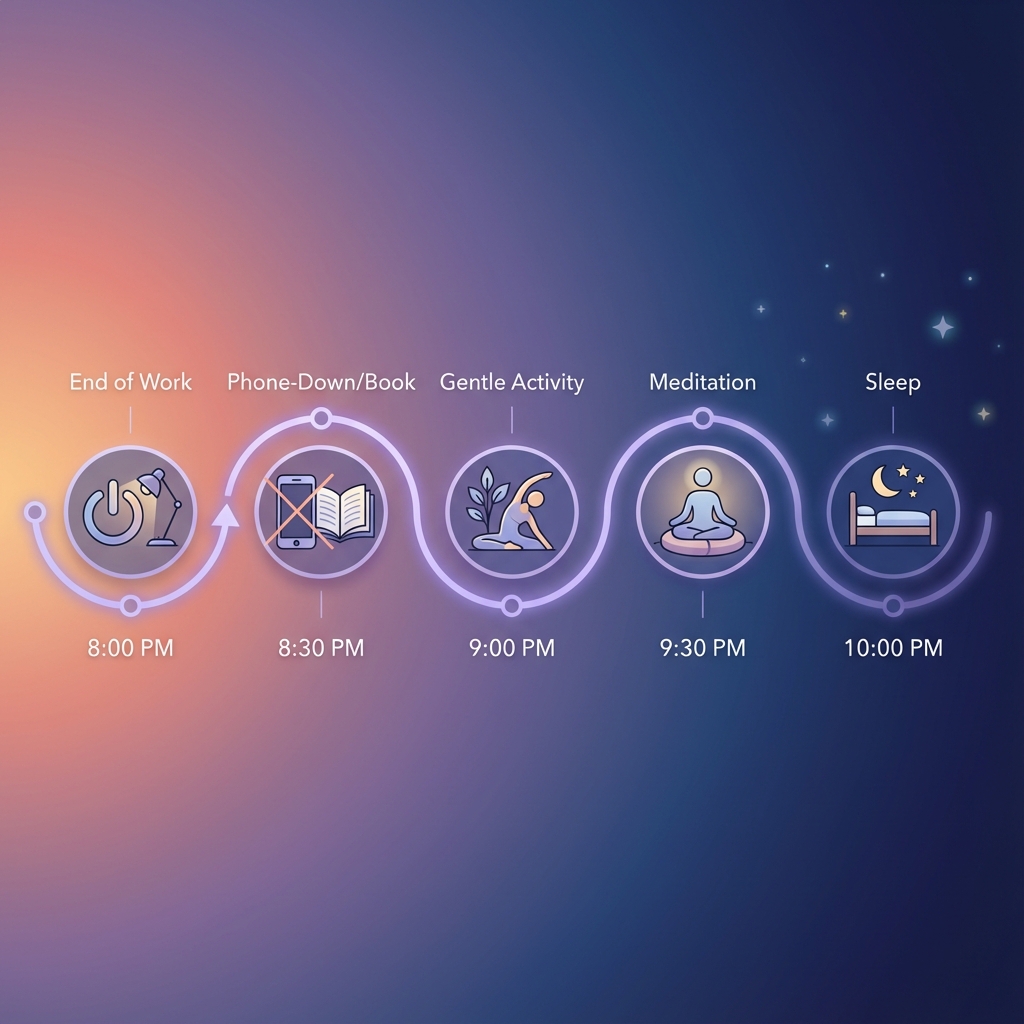
A simple, effective evening routine:
1. Consistent stop time. At least 30-60 minutes before intended sleep, major activities stop.
2. Screens off (or limited). Blue light and stimulation aren’t ideal pre-sleep. Phone down or heavily filtered.
3. Gentle activity. Reading, light stretching, quiet conversation, relaxing music.
4. Meditation. 10-20 minutes of practice specifically for sleep preparation.
5. Bed. Lights off, sleep invited.
This sequence creates consistent transition from day to night.
What evening meditation should include
Evening practice differs from daytime practice:
Emphasis on relaxation over alertness. Not energising breath work or focused concentration.
Body focus. Body scan, progressive muscle relaxation. Physical release.
Slow pace. No hurry. Extended pauses. Gradual deepening.
Release orientation. Letting go of the day rather than building toward action.
Sleep-compatible ending. Not returning to full alertness, but allowing drift toward sleep.
Evening techniques that work
Body scan
Systematically moving through the body, noticing and releasing tension. Classic pre-sleep practice.
- Start at feet, move upward
- Notice each body region
- Release tension
- Allow heaviness
Progressive muscle relaxation
Tensing muscle groups then completely releasing.
- Tense for 5-10 seconds
- Release completely
- Notice the contrast
- Move to next area
The release teaches muscles to relax more deeply.
Breath slowing
Progressively slower breathing.
- Start at normal pace
- Each minute, slightly slower
- Extended exhales
- Minimal effort by end
This naturally activates sleep-compatible nervous system state.
Gratitude and release
Processing the day through appreciation and letting go.
- What are you grateful for from today?
- What are you ready to release?
- Tomorrow is tomorrow — tonight is rest
This closes the mental loops that keep you awake.
Sleep visualisation
Imagining the process of falling asleep.
- Seeing yourself relaxed in bed
- Feeling drowsiness arriving
- Watching consciousness drift
- Imagining restful sleep
The brain prepares for what’s vividly imagined.
What AI evening meditation adds
AI meditation enhances evening practice:
Day integration. When you share how your day was, the session helps process it.
Tension focus. Where are you holding tension tonight? Sessions adapt.
Worry processing. If specific concerns are keeping you up, they can be acknowledged and released.
Progressive approach. Sessions don’t just relax — they systematically move toward sleep-readiness.
Sleep-specific content. Sessions designed to lead into sleep, not return you to alertness.
Building the evening habit
Evening routines require consistency:
Same time each night
Bodies thrive on rhythm. Consistent sleep times improve sleep quality.
Pick a target and honour it most nights.
Same sequence
The sequence becomes a cue: body learns “after meditation comes sleep.”
Consistent pattern = stronger association.
Protect the transition time
This isn’t optional spare time to be borrowed. It’s functional sleep preparation.
Guard it like you’d guard sleep itself.
No excuses for short-cutting
Tired and want to skip meditation? That’s exactly when you need it.
The routine isn’t a bonus — it’s the infrastructure for sleep.
Sample evening routines
Minimal (30 minutes before bed)
9:30 - Screens off, phone charges elsewhere 9:35 - Brief stretching 9:40 - 15-minute meditation 9:55 - Prepare for bed, lights off at 10:00
Standard (60 minutes before bed)
9:00 - Work/activity stops 9:05 - Light reading or relaxing activity 9:30 - 20-minute meditation 9:50 - Prepare for bed 10:00 - Lights off
Extended (90 minutes before bed)
8:30 - Work stops 8:35 - Light meal if needed 9:00 - Relaxing activity (reading, music, gentle craft) 9:30 - 20-30 minute meditation 10:00 - Prepare for bed, lights off
Minimal-effort version
When you have almost no time:
- 5-minute meditation in bed
- Better than nothing
- Sleep directly after
The phone problem
The biggest evening routine enemy: the phone.
Not just blue light (though that matters). The phone brings:
- Work intrusions
- Social stimulation
- Comparison triggers
- News anxiety
- Infinite scroll
Phone-free evening times are foundational.
If you use phone for meditation audio, put it in airplane mode first.
When sleep doesn’t come
Sometimes despite good routine, sleep eludes:
Don’t force it. Trying hard to sleep prevents sleep.
Use the wakefulness. If you’re lying awake, try a meditation. Better than frustration.
Accept the experience. Sometimes you won’t sleep well. One night won’t ruin you.
Return to routine tomorrow. Consistent routine over time matters more than any single night.
Evening meditation vs sleep meditation
Subtle distinction:
Evening meditation: Done before bed preparation. Formal practice. Returns to light activity and bed preparation afterward.
Sleep meditation: Done in bed with intention to sleep during or immediately after. Not returning to activity.
Both are valid. You might use evening meditation to wind down, then sleep meditation as you actually try to fall asleep.
Common evening mistakes
Screens until the last minute. Then wondering why your mind races in bed.
Exercise too late. Intense exercise energises. Keep it early evening or before.
Caffeine too late. Sensitivity varies, but caffeine affects sleep for many. Afternoon cutoff for most.
Heavy late meals. Digestion and sleep don’t mix well. Light evening eating.
Trying to sleep immediately. After intense work or stimulation, direct to bed fails. Transition time matters.
Long-term benefits
With consistent evening routine:
Sleep onset improves. Fall asleep faster as routine becomes ingrained.
Sleep quality improves. Deeper, more continuous sleep over time.
Sleep anxiety reduces. You know how to prepare; sleep becomes less fraught.
Overall wellbeing benefits. Better sleep improves everything else.
The investments compound. Six months of consistent routine creates significantly better sleep than you have now.
The bottom line
Evening meditation isn’t optional extra. It’s functional preparation.
Your body needs transition. Your mind needs release. Your system needs the cue that sleep is coming.
A consistent routine — with meditation as centrepiece — provides this.
AI meditation adapts to your evenings: processing your specific day, targeting your specific tensions, leading you toward your specific sleep.
End well, sleep well.
Ready to build your evening routine? Get started with two free sessions per day — and transform how you end each day.