You’ve tried meditation before. Maybe several times. It worked while you did it, but somehow the practice never stuck. Life got busy, the app notifications became background noise, and now your previous attempts are just forgotten downloads.
Building a consistent meditation practice isn’t about willpower. It’s about understanding what makes habits stick and designing your practice to work with your life, not against it.
Why Meditation Practices Fail
Understanding failure patterns helps avoid them:
Too Ambitious
Starting with 30-minute daily sessions when you’ve never meditated is like training for a marathon by running 26 miles on day one.
No Anchor
“I’ll meditate when I have time” means never meditating. Without a specific time and trigger, practice gets squeezed out.
Perfectionism
Missing one day and thinking “I’ve failed” leads to abandoning the entire practice.
Wrong Approach
Not all meditation styles suit all people. If guided meditation frustrates you, you won’t do it.
No Flexibility
A practice that only works in perfect conditions doesn’t survive real life.
Principles of Sustainable Practice
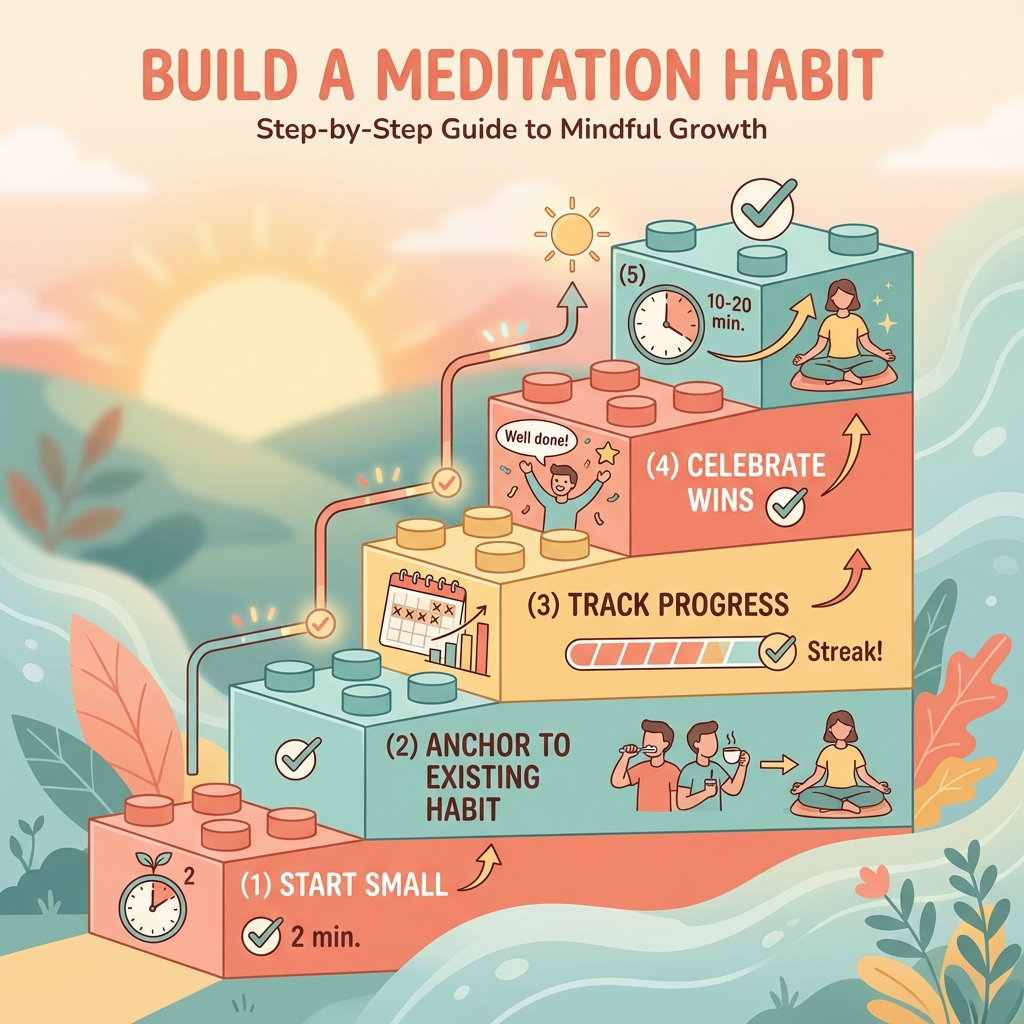
Start Absurdly Small
The initial goal isn’t transformation—it’s habit formation:
- Week 1-2: 3 minutes
- Week 3-4: 5 minutes
- Month 2: 10 minutes
- Month 3+: Build from there
Success with 3 minutes builds confidence for 5 minutes. Failure with 30 minutes builds shame.
Anchor to Existing Behavior
Attach meditation to something you already do:
- After brushing teeth
- Before first cup of coffee
- After arriving home from work
- Before bed
The existing habit becomes the trigger. No decision-making required.
Make It Obvious
Reduce friction between intention and action:
- Meditation app on home screen
- Headphones ready by meditation spot
- Chair or cushion waiting where you’ll see it
Make It Easy
Remove obstacles:
- Phone in do-not-disturb mode automatically at meditation time
- Same time and place each day
- Everything you need already prepared
Don’t Break the Chain (But Forgive Breaks)
Consistency matters most:
- Track your practice visually (calendar marks)
- Let the streak become its own motivation
- BUT: missing one day doesn’t break the practice—missing two days is a pattern
Have a Minimum Viable Practice
For the hardest days:
- Even 1 minute counts
- Even a few conscious breaths counts
- The goal is never zero
Setting Up Your Practice
Choose Your Time
| Time | Pros | Cons |
|---|---|---|
| Morning | Freshest mind, least distraction | Must wake earlier, grogginess |
| Midday | Breaks up day, prevents afternoon slump | Many people are busy, harder to protect |
| Evening | Natural wind-down, flexible timing | Fatigue can lead to skipping or sleeping |
Choose based on your lifestyle and protect that time fiercely.
Choose Your Place
Ideally:
- Quiet enough (not silent necessarily)
- Consistent (same spot builds association)
- Comfortable (you’ll use it more)
- Accessible (reduce friction)
But any place works if needed. Don’t let imperfect environment become an excuse.
Choose Your Approach
AI meditation offers flexibility:
- Fully guided: AI leads everything
- Semi-guided: Timer with occasional guidance
- Timed silence: Just a timer and bells
Experiment to find what resonates. Different days might need different approaches.
The First 30 Days
Days 1-7: Establish Routine
- Same time, same place
- Very short (3-5 minutes)
- Focus on showing up, not quality
Days 8-14: Minor Expansion
- Possibly extend to 7-10 minutes
- Explore different session types
- Solidify the habit
Days 15-21: Navigate Obstacles
- This is when most practices fail
- Use minimum viable practice on hard days
- Expect and plan for obstacles
Days 22-30: Consolidation
- Practice begins to feel natural
- Duration can increase based on preference
- Habit structure is established
After 30 days, you have a practice. Now you’re maintaining and developing it, not fighting to create it.
Common Obstacles and Solutions
“I Don’t Have Time”
You have time; you haven’t prioritised it:
- Start with 3 minutes (everyone has 3 minutes)
- Identify what you’ll sacrifice (5 minutes of scrolling?)
- Recognise that “no time” means “low priority”
“I Keep Forgetting”
You need stronger triggers:
- Set phone alarms
- Attach to existing habits
- Put visual reminders in your environment
“My Mind Wanders Too Much”
That’s not a problem—that’s meditation:
- Noticing wandering IS the practice
- Every return to focus is a rep
- Less wandering comes with time
“I Don’t Know If It’s Working”
Progress is subtle:
- Track mood, sleep, stress over weeks
- Don’t expect daily revelations
- Benefits often show up elsewhere in life
“Life Got Crazy”
Use minimum viable practice:
- 1 minute is better than zero
- Maintain connection to practice even when full practice isn’t possible
- Return to full practice when chaos subsides
“I’m Bored With It”
Time to vary:
- Try different meditation types
- Explore different AI guidance styles
- Add a secondary session at different time
Making It Through Plateaus
Practice often follows patterns:
- Initial enthusiasm: Everything is new and interesting
- Plateau: Seems like nothing is happening
- Frustration: “Why am I doing this?”
- Breakthrough or abandonment: The pivot point
Plateaus are not signs of failure—they’re required transitions. The practice deepens during plateaus, not despite them.
“What got you here won’t get you there. The plateau is where you’re consolidating, building foundation for next growth.”
Long-Term Practice Development
Month 1-3: Consistency
Focus entirely on showing up. Quality doesn’t matter; presence does.
Month 4-6: Exploration
Try different techniques:
- Body scan
- Loving-kindness
- Visualisation
- Different session lengths
Find your preferences while maintaining consistency.
Month 7-12: Deepening
- Potentially longer sessions
- Retreat days or extended practice
- Integrating insights into daily life
Year 2+: Personalisation
- Your practice becomes uniquely yours
- You know what works in different situations
- Flexibility within commitment
Frequently Asked Questions
How long until meditation “works”?
Subtle effects often appear within weeks. Deeper changes emerge over months. It depends what you mean by “works.”
What if I miss a day?
Notice it, don’t judge it, return tomorrow. One missed day is nothing. Two is a pattern—check in with yourself.
Should I meditate when I don’t want to?
Usually yes. The days you resist are often the days you need it most. Use minimum viable practice.
Can I meditate more than once a day?
Absolutely. Many people develop morning and evening practices, plus situational sessions.
What if my practice stays at 5 minutes forever?
That’s fine. Consistency at 5 minutes beats inconsistency at 20. But if you want to extend, do it gradually.
The Bottom Line
Building a meditation practice is less about meditation skill and more about habit architecture. Start so small it’s almost embarrassing, anchor to existing routines, protect the time fiercely, and use minimum viable practice on hard days. The goal isn’t perfect meditation—it’s persistent practice. Everything else follows from that foundation.