You’re not hungry, but you’re already in the kitchen. The stress of the day is sitting heavy, and chocolate seems like the only thing that will help. Ten minutes later, you feel worse—the stress is still there, but now guilt and discomfort have joined it.
Emotional eating isn’t about willpower. It’s about using food to manage feelings. AI hypnosis offers a way to address this pattern at its root: the emotions driving the eating.
Understanding Emotional Eating
Emotional eating is using food for reasons other than physical hunger:
- Stress eating: Food as relief from pressure
- Comfort eating: Food as soothing for difficult emotions
- Boredom eating: Food as stimulation when life feels flat
- Reward eating: Food as celebration or compensation
- Numbing eating: Food to avoid feeling anything
None of these are character flaws. They’re patterns your nervous system learned, often in childhood, and they’re reinforced by the genuine (if temporary) relief food provides.
Why Diets Fail for Emotional Eaters
Diets address what you eat, not why you eat. For emotional eaters, restriction often backfires:
- Restriction creates stress, which triggers emotional eating
- “Forbidden” foods become more psychologically appealing
- Willpower fails when emotions are strong enough
- The underlying emotional need remains unaddressed
This is why hypnosis is effective: it works with the emotional patterns, not just the eating behavior.
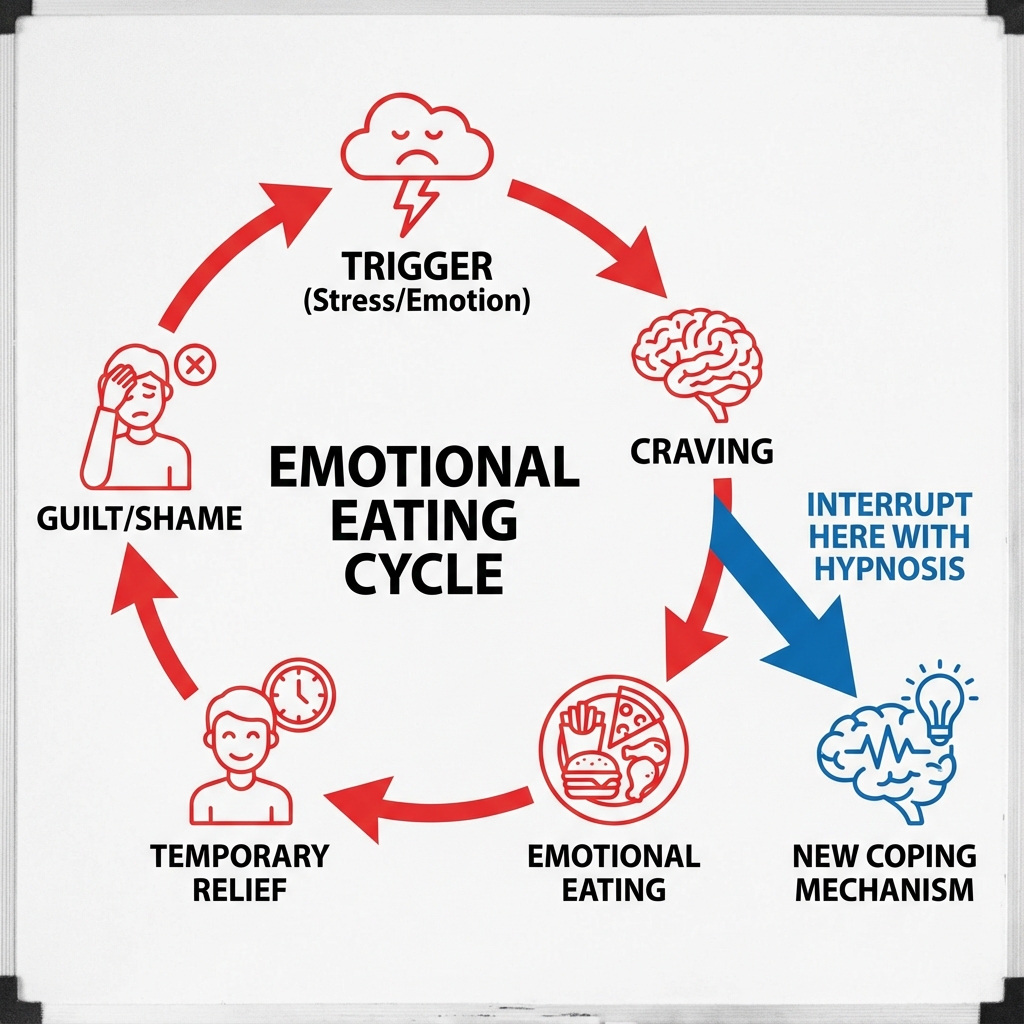
How AI Hypnosis Addresses Emotional Eating
Separating Physical and Emotional Hunger
The first step is recognising which hunger you’re feeling:
“Notice the sensation you’re calling hunger. Where is it located? When did it start? Does it demand specific foods or would anything satisfy it? Emotional hunger often appears suddenly, wants specific comfort foods, and sits in the chest rather than stomach. Physical hunger builds gradually and accepts diverse foods. Practice distinguishing between them.”
Processing Emotions Without Food
Emotional eating works (temporarily) because it changes your emotional state. Hypnosis teaches alternative emotional processing:
“When difficult feelings arise, you’ve learned to reach for food. But food doesn’t dissolve feelings—it only covers them. Now, practice sitting with a feeling without immediately trying to change it. Notice it. Name it. Let it exist. Feelings move and shift on their own when allowed to.”
Building New Neural Pathways
Through repetition, hypnosis creates alternative responses:
“The trigger arises—stress, boredom, sadness. Notice your old pattern: ‘I want to eat.’ Now feel a new pathway forming. The same trigger, but a different response: ‘I want to breathe. I want to move. I want to feel this and let it pass.‘”
Healing the Original Wound
For many, emotional eating began in childhood:
“When you were young, food might have meant love, or safety, or the only comfort available. Your nervous system learned this equation. Now, as an adult, you can provide yourself with different sources of comfort. Food doesn’t need to do that job anymore.”
Practical Techniques
The Pause Practice
When you feel drawn to eat emotionally:
- Pause for 90 seconds (emotions peak within 90 seconds)
- Ask: “What am I actually feeling?”
- Ask: “What do I actually need?”
- Breathe through the emotional wave
- Choose consciously whether to eat
AI hypnosis can guide you through this in real-time.
The Emotional Inventory
Regular hypnosis to check in with feelings: “How am I right now? Not how do I think I should be—how am I actually? Is there sadness I haven’t acknowledged? Anger I’m suppressing? Loneliness I’m trying not to feel? Let whatever is there be there.”
The Alternative Menu
Building a list of non-food responses to emotional triggers:
- Stress → Walk, breathwork, hypnosis
- Sadness → Music, journaling, talking to someone
- Boredom → Create, move, explore
- Loneliness → Reach out, connect, commune with yourself
- Anger → Move, express, process
Hypnosis helps install these alternatives as automatic responses.
The Self-Compassion Layer
Emotional eating often comes with harsh self-criticism, which then triggers more emotional eating. This cycle must be broken:
“When you eat emotionally, you’re trying to care for yourself. The method isn’t ideal, but the intention is kind. Treat yourself as you would a friend who’s struggling—not with harsh judgment, but with compassion and curiosity.”
Addressing Different Emotional Triggers
Stress Eating
“Stress creates tension that wants release. Food provides temporary relief by shifting your nervous system away from threat. But the stress doesn’t dissolve—it just gets covered over. Let’s build new stress responses that actually reduce stress rather than mask it.”
Comfort Eating
“When you needed comfort as a child, food might have been the most reliable source. Your brain learned: distress → food → relief. That pattern made sense then. Now you have more options. You can comfort yourself through presence, through breath, through kindness.”
Boredom Eating
“Boredom is actually a quiet form of restlessness—you want stimulation. Food provides stimulation, but it’s not what you really want. Practice asking: ‘What would be genuinely interesting right now?’ Learn to tolerate boredom briefly while you figure out the answer.”
Numbing Eating
“Sometimes you eat to feel nothing. Life has become too much, and unconscious chewing provides escape. But what you’re escaping from remains, waiting. What if you could face it in small doses, with support, rather than hiding from it forever?”
Building Long-Term Change
Phase 1: Awareness
- Daily AI hypnosis to build emotional awareness
- Tracking emotional eating episodes without judgment
- Learning to distinguish physical from emotional hunger
Phase 2: Interruption
- Using hypnosis in moments of emotional eating urge
- Practicing the pause
- Building alternative response options
Phase 3: Transformation
- Deeper hypnotic work on origins of emotional eating
- Healing childhood patterns
- Installing new automatic responses
Phase 4: Maintenance
- Ongoing practice to maintain new patterns
- Processing emotional eating episodes when they occur
- Continued self-compassion work
When to Seek Additional Support
Emotional eating exists on a spectrum. Consider professional support if:
- Eating patterns cause significant distress
- You can’t stop eating even when you want to
- Physical health is affected
- Eating patterns are accompanied by purging or restriction
- Depression or anxiety is significant
AI hypnosis works well alongside therapy and, for eating disorders, is best used as a complement to specialised treatment.
What Changes Look Like
People who address emotional eating often report:
- Eating in response to physical hunger more often
- Feeling more present with food when eating
- Reduced guilt and shame around eating
- Better emotional awareness overall
- Weight may change, but more importantly, relationship with food changes
- Less mental energy consumed by food thoughts
Frequently Asked Questions
Will I lose weight with AI hypnosis?
Possibly, but that’s not the primary goal. The goal is a healthier relationship with food and emotions. Weight changes often follow, but the focus is on the pattern, not the scale.
What if I don’t know what I’m feeling?
That’s common for emotional eaters—food has been masking feelings for so long that they’re unfamiliar. Hypnosis helps you slowly build emotional vocabulary and awareness.
How long until I see changes?
Some people notice shifts within a few sessions. Deep pattern change typically requires consistent practice over 4-8 weeks.
What if I still eat emotionally sometimes?
That’s normal and doesn’t mean failure. The goal is progress, not perfection. Over time, emotional eating becomes less frequent and less intense.
Do I have to feel all my feelings forever?
Not all at once. The ability to feel emotions actually makes them less overwhelming—when you’re not afraid of feelings, they pass through more quickly.
The Bottom Line
Emotional eating is a learned pattern of using food to manage feelings. Diets don’t address it because they focus on the eating, not the emotions. AI hypnosis offers a different approach: learning to feel your feelings, building alternative responses to emotional triggers, and gradually transforming your relationship with food. You don’t need more willpower. You need more emotional alternatives.