3 AM. You’re wide awake. You’ve been in bed for hours.
Your mind runs through tomorrow’s schedule. Replays uncomfortable conversations. Worries about what happens if you don’t sleep tonight.
You’ve tried the usual advice. No screens before bed. Cool room. Consistent schedule. It helps somewhat but doesn’t solve the underlying problem.
The problem is your mind doesn’t know how to switch off.
AI hypnosis addresses this directly.
Why insomnia persists
Insomnia isn’t usually about the body. Your body can sleep. The problem is the mind interfering.
Common patterns:
Racing thoughts. The mind keeps generating content. Planning, worrying, analysing. It doesn’t settle.
Hyperarousal. Your nervous system is stuck in alert mode. Even when tired, there’s an underlying activation.
Anxiety about sleep itself. You worry about not sleeping, which keeps you awake, which increases worry. A vicious cycle.
Learned association. Your bed has become associated with wakefulness and frustration rather than sleep.
Standard sleep hygiene addresses environmental factors but not these mental patterns.
How hypnosis helps sleep
Hypnosis works at the level where insomnia lives — the unconscious patterns keeping you awake.
Progressive relaxation. Systematically relaxing the body, far beyond “trying to relax.” Physical relaxation precedes and enables mental relaxation.
Attention narrowing. The busy mind has attention scattered everywhere. Hypnosis focuses attention on simple, sleep-conducive content — breath, body, peaceful imagery.
Suggestion installation. While relaxed, suggestions about easy sleep take hold: “When your head touches the pillow, you’ll feel a wave of drowsiness.”
Breaking associations. Repeated experiences of calm relaxation in bed rebuild the bed-sleep association, breaking the bed-anxiety link.
Reducing hyperarousal. Regular hypnosis trains the nervous system that it’s safe to shift into parasympathetic mode.
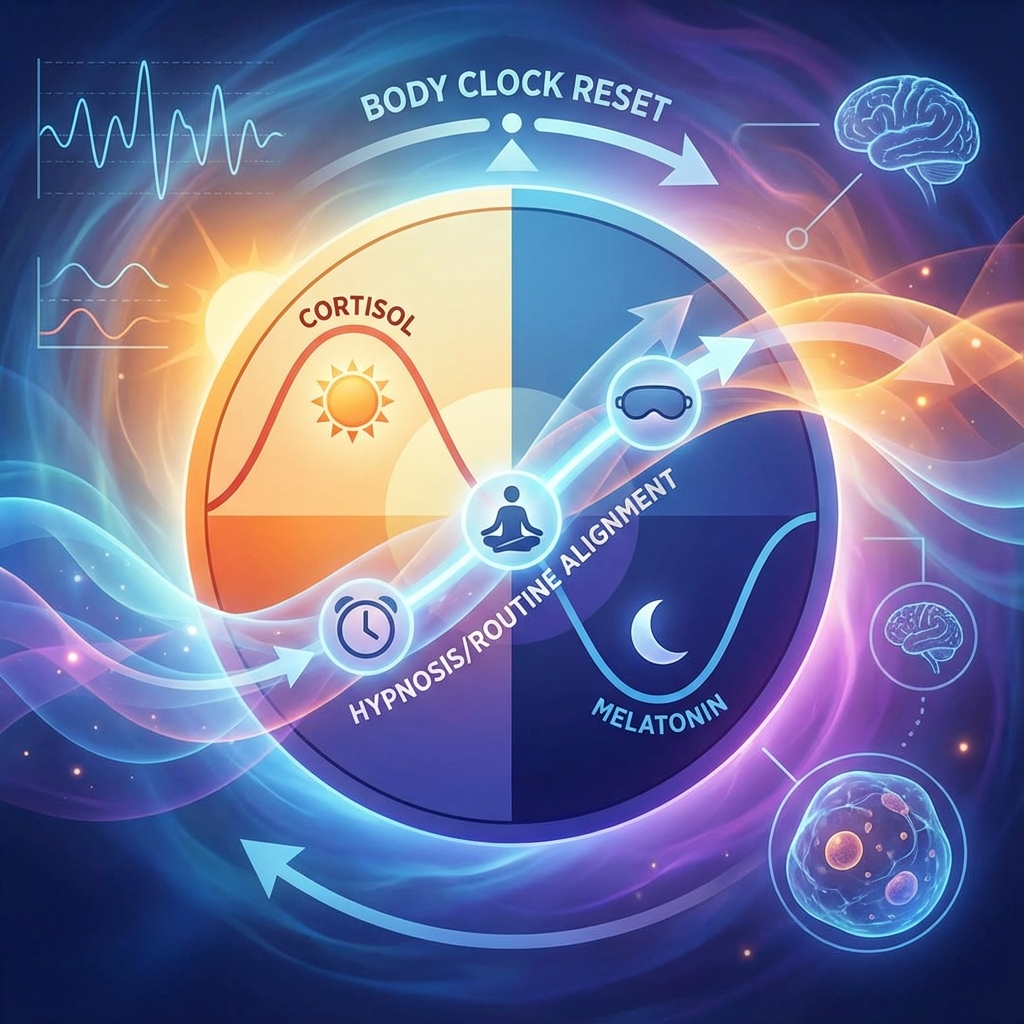
What an AI hypnosis session for sleep might include
When you tell the AI you’re struggling with sleep:
Check-in context. What’s making sleep difficult? Is it falling asleep, staying asleep, early waking? What’s on your mind?
Progressive induction. A thorough relaxation sequence — much deeper than you’d achieve on your own. Body part by body part, letting go of tension.
Imagery. Perhaps descending stairs, with each step bringing more drowsiness. Or floating on calm water. Or watching stars.
Sleep-specific suggestions. “Sleep is already arriving… the body knows how to sleep… thought can slow and fade…”
Transition to actual sleep. The session can be designed to lead into actual sleep, not to return you to full alertness.
The AI creates this for your specific situation. If work stress is keeping you awake, the session might include releasing work thoughts. If physical discomfort is an issue, more body-focused relaxation.
Why AI personalisation matters for sleep
Generic sleep recordings exist. They can help. But they miss nuance.
Maybe falling asleep isn’t your problem — it’s 4 AM waking. The AI creates content for that specifically.
Maybe your mind loops on a particular worry. The session can address that worry directly.
Maybe body tension is concentrated in your shoulders and jaw. The session focuses relaxation there.
This personalisation makes content more relevant, which increases engagement, which improves effectiveness.
How to use AI hypnosis for sleep
The practical approach:
Use it in bed. Unlike daytime hypnosis, sleep hypnosis is designed to lead into actual sleep. Do it in bed, ready to sleep.
Headphones or pillowfall speakers. Good audio is important. Consider sleep-friendly headphones or speakers that won’t disturb you.
Do it regularly. Occasional use helps occasionally. Nightly use trains your brain to expect the routine to lead to sleep.
Lower volume as session progresses. Some people find it helpful to have volume fade toward the end.
Keep expectations reasonable. You might not fall asleep during the session. That’s fine. The relaxation still helps, and sleep often comes shortly after.
Comparing to sleep medication
Sleep medication works — but carries considerations:
Dependency risk. Some sleep medications create physical dependency. Stopping them causes rebound insomnia.
Side effects. Drowsiness next day, cognitive effects, interaction with other medications.
Doesn’t address causes. Medication forces sleep but doesn’t change the patterns keeping you awake.
Diminishing effectiveness. Tolerance can develop, requiring higher doses.
AI hypnosis has none of these issues:
- No physical dependency
- No side effects
- Actually addresses underlying patterns
- Effectiveness improves with practice
For occasional insomnia, medication has a place. For chronic sleep issues, non-drug approaches like AI hypnosis address root causes.
What about sleep stories?
Apps like Calm popularised “sleep stories” — soothing narratives to fall asleep to. AI hypnosis takes a different approach.
Sleep stories are passive entertainment. They work by giving your mind something benign to focus on, hopefully boring enough to drift off.
AI hypnosis is active intervention. It directly guides you into relaxation, delivers suggestions for sleep, and trains your nervous system.
Both can help. But hypnosis does more than distract — it changes patterns.
Addressing specific insomnia types
AI hypnosis can target different insomnia presentations:
Can’t fall asleep: Sessions focused on transitioning from waking to sleep. Progressive deepening, increasing drowsiness cues.
Wake in the middle of the night: Sessions with suggestions for continuous sleep, for returning quickly to sleep if waking occurs.
Wake too early: Sessions addressing the pattern of early alertness, deepening sleep toward morning.
Anxiety-driven insomnia: Sessions directly addressing the worries keeping you awake, combined with relaxation.
Sharing your specific pattern in the check-in produces appropriately targeted content.
Building sleep habits
For chronic insomnia, consistency matters:
Use hypnosis nightly. The more your brain experiences the routine leading to sleep, the stronger the pattern becomes.
Combine with sleep hygiene. Hypnosis doesn’t replace good sleep practices — consistent schedule, appropriate environment, wind-down routine.
Track patterns. Notice what’s improving. Falling asleep faster? Fewer wakings? Better sleep quality?
Be patient. Sleep patterns built over years don’t resolve in days. Give it weeks of consistent practice.
When to seek professional help
AI hypnosis is a tool, not a treatment for all sleep disorders.
Consider professional help if:
- Insomnia persists despite consistent self-help efforts
- You suspect sleep apnoea (loud snoring, gasping)
- There are significant mental health issues involved
- Daytime functioning is severely impaired
A sleep specialist can diagnose underlying conditions. A therapist can address anxiety or depression contributing to insomnia.
Hypnosis can complement professional treatment but doesn’t replace it when needed.
The natural sleep alternative
Your body knows how to sleep. It did it every night of your childhood without thinking.
Somewhere along the way, interference crept in — stress, worries, hyperarousal, bad associations.
AI hypnosis helps clear the interference. It trains your mind to settle, your body to relax, your system to let go into sleep.
No drugs. No side effects. Progressive improvement as practice accumulates.
Sleep is natural. Sometimes it just needs help returning to its natural state.
Ready for better sleep without medication? Get started with two free sessions per day — let tonight be the beginning of natural, restful sleep.