It’s 1:47 am. You know because you just checked your phone. Again.
Your mind is doing that thing where it replays conversations from three days ago, plans tomorrow’s to-do list, and somehow manages to worry about climate change all at the same time. You know you need to sleep. That knowledge makes everything worse.
Sound familiar?
Sleep problems are frustrating because they’re self-reinforcing. The more you worry about not sleeping, the harder it becomes to sleep. Traditional advice — “just relax,” “put your phone away,” “think calm thoughts” — is about as useful as telling someone who’s drowning to “just stop panicking.”
This is where AI meditation (and particularly AI hypnosis) has become genuinely useful for me.
Why sleep is different from daytime anxiety
During the day, you have distractions. Work, conversations, tasks — these occupy your conscious mind and give your anxious thoughts somewhere to compete.
At night, lying in the dark, there’s nothing else. Your mind has free reign. Every worry gets amplified. Every fear gets rehearsed. We explore the connection between sleep and anxiety in more depth elsewhere.
Standard meditation can help, but there’s a challenge: most meditation techniques require some level of active engagement. “Follow your breath.” “Observe your thoughts.” “Scan your body.” These ask you to do something.
What you actually need at 2am is the opposite. You need your active mind to stop. To let go. To drift.
This is where hypnosis techniques shine.
Meditation vs hypnosis for sleep
Both AI meditation and AI hypnosis can help with sleep, but they work differently:
AI meditation helps you observe racing thoughts without getting swept up in them. It’s useful early in the evening, when you want to wind down and transition from “active brain” to “rest brain.” Good for pre-sleep routines.
AI hypnosis goes deeper. Through progressive relaxation and guided visualisation, it helps your conscious mind step aside entirely. Your thoughts slow. Your body relaxes. You drift into a state where sleep becomes natural rather than forced.
At InTheMoment, we offer both. Meditation for winding down earlier in the evening, and hypnosis for when you actually want to fall asleep.
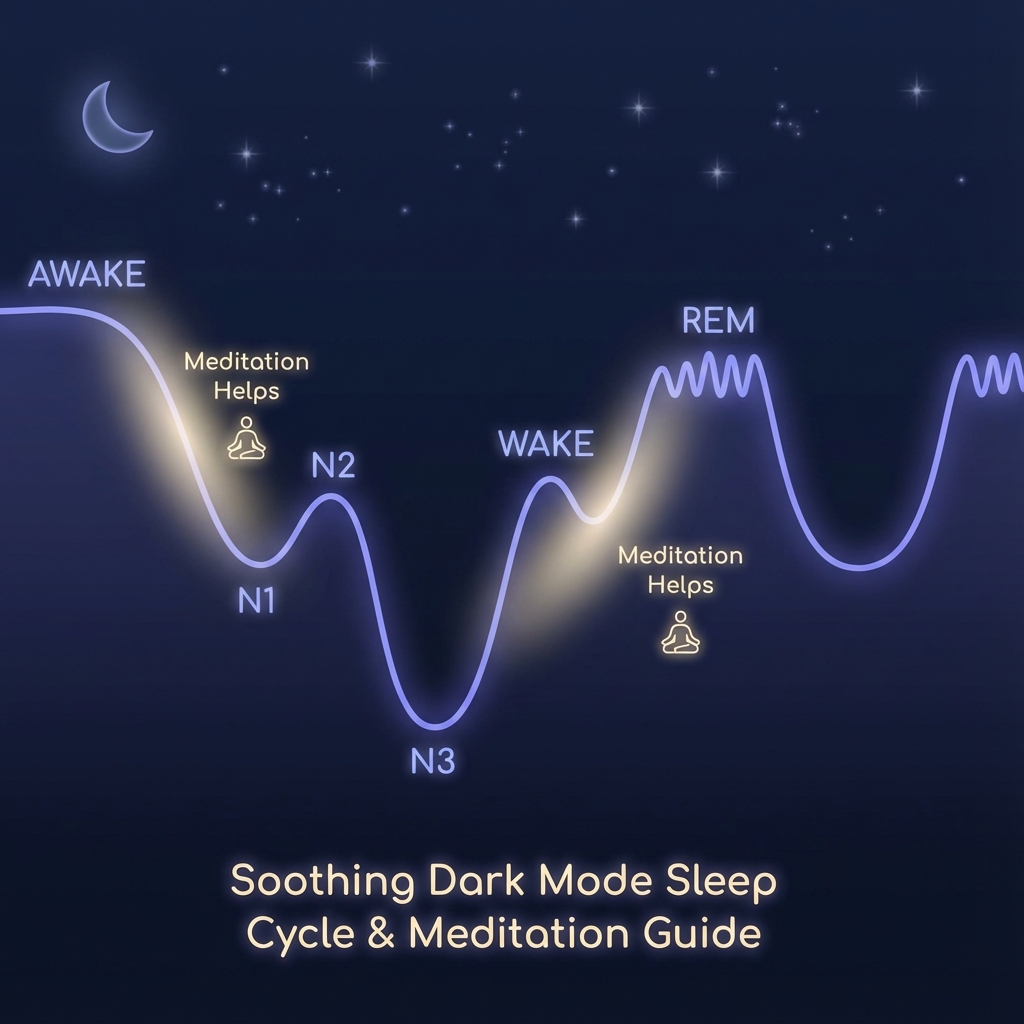
What a sleep hypnosis session actually does
Let me walk through what happens in a sleep-focused AI hypnosis session:
The check-in. Before the session, you share what’s keeping you awake. Maybe it’s work stress. Maybe it’s a conversation you’re dreading tomorrow. Maybe it’s diffuse anxiety with no clear cause. The AI uses this to tailor what comes next.
Progressive relaxation. The session guides you to systematically relax your body, starting from your feet and moving upward. Each muscle group releases. Your body becomes heavy.
This isn’t just relaxation for its own sake — it’s interrupting the tension-thought loop. When your body is tight, your mind stays alert. When your body truly relaxes, your mind follows.
Visualisation. You’re guided to imagine a calm, safe place. Maybe descending a staircase, each step taking you deeper into rest. Maybe walking along a quiet beach as the sun sets.
The content adapts to you. If you mentioned you’re worried about tomorrow’s meeting, the visualisation might include a sense of that meeting going well — not to solve the problem, but to remove it as a block to sleep.
Fade to sleep. Unlike daytime sessions, sleep hypnosis doesn’t bring you back to alertness. The voice gradually quiets. The pauses lengthen. You’re left drifting, with nothing pulling you back to wakefulness.
Most people don’t hear the end of the session. That’s the point.
What makes AI personalisation matter for sleep
Here’s why personalisation specifically helps with sleep:
Your thoughts are specific. Generic sleep meditations say things like “let go of your worries.” But your worries have names. They have faces. They have deadlines. A session that acknowledges what’s actually on your mind — without solving it, just acknowledging it — is more effective at creating mental distance.
Your body tension is specific. Some people hold tension in their jaw. Others in their shoulders. Others in their stomach. The AI can ask about this and focus relaxation where you actually need it.
Your environment matters. Are you in a silent room or is there traffic outside? Are you hot or cold? These details affect what techniques work best. Eyes-open techniques might be appropriate if you’re in an unfamiliar hotel room. Breath counting might be counterproductive if you’re congested.
A session created for your specific moment handles all of this automatically.
My personal sleep routine
I’ve experimented a lot with what works for me. Here’s my current approach:
Early evening (around 8pm): A short AI meditation session focused on processing the day. Not specifically for sleep — just for mentally closing work and transitioning to personal time.
30 minutes before bed: No screens. I read, usually something not too stimulating.
In bed: When I actually want to fall asleep, I start an AI hypnosis session optimised for sleep. I set it to 20 minutes, lying down, eyes closed.
I usually fall asleep within 10-15 minutes. I’ve never intentionally heard the end of a session.
If I wake at 3am: If my mind starts racing in the middle of the night, I’ll start another short session rather than lying there battling my thoughts. It works faster than fighting.
What about sleep stories and other apps?
Sleep stories — the long, meandering narratives offered by apps like Calm — can work for some people. They give your mind something to follow that’s more interesting than your anxious thoughts, but boring enough not to engage you fully.
The challenge is that they’re not personalised. If you’re stressed about a specific thing, a story about a train journey through Scotland doesn’t address that stress. It’s just… distraction.
AI hypnosis is different because it actually works with your current mental state. The relaxation techniques address your body tension. The visualisations can incorporate (and resolve) your specific concerns.
Is it magic? No. But for me, it’s more effective than passively listening to someone describe a forest for 45 minutes. For a full comparison of what’s available, see our best sleep meditation apps guide.
Techniques that work for sleep
Based on my experience and what I’ve learned from using InTheMoment, here are techniques that actually help:
Progressive muscle relaxation. Tensing and releasing muscle groups, one by one. It sounds too simple to work, but the physical release genuinely triggers mental release.
Breathing patterns that emphasise the exhale. Longer exhales activate your parasympathetic nervous system — the “rest and digest” mode. A 4-count inhale and 6-count exhale is a good starting point.
Counting down rather than up. Your mind associates counting up with activity and progress. Counting down — from 10, from 100, from 50 — suggests descent, winding down, approaching zero.
Permission-based language. “Allow yourself to drift” rather than “You WILL fall asleep.” Sleep can’t be forced. Permissive language removes the pressure that keeps you awake.
Not caring about the outcome. The irony of sleep is that trying harder makes it harder. The best techniques create conditions for sleep without demanding it.
A note on serious sleep issues
I want to be clear about something: AI meditation and hypnosis are tools for everyday sleep challenges. Trouble falling asleep because you’re stressed. Waking in the night with racing thoughts. General restlessness.
They’re not treatments for clinical insomnia, sleep apnea, or other medical sleep disorders. If you’re experiencing persistent, severe sleep problems, please see a healthcare professional.
That said, for the common, frustrating, non-clinical sleep struggles that most of us experience — the “my brain won’t shut up” variety — these techniques can genuinely help.
Getting started
If you’re curious about trying AI meditation or hypnosis for sleep, here’s my suggestion:
Start with an evening meditation. Use it a few hours before bed to process the day and begin winding down. This helps establish that you’re transitioning from work-mode to rest-mode.
Try a sleep hypnosis session when actually in bed. Set the app to hypnosis mode, choose a 15-20 minute session, and let it guide you down. Don’t worry about staying awake for the whole thing — falling asleep mid-session is success, not failure.
Use it consistently. Like any habit, the benefits compound. Your mind starts to associate the session with sleep. The relaxation becomes easier each time.
At InTheMoment, you get two free sessions per day, which is plenty to establish a routine. No credit card required to start.
The bottom line
Poor sleep makes everything harder. Focus, mood, relationships, health — all suffer when you’re not resting properly.
The challenge is that sleep can’t be demanded. It has to be invited. And that’s hard when your mind is full of the day’s worries.
AI meditation and hypnosis help create the conditions for sleep. The science behind sleep meditation explains why these techniques work. They address your specific mental state, relax your specific physical tension, and guide you toward rest without demanding that you achieve it.
It’s not a cure-all. Nothing is. But for me, it’s become an essential part of sleeping well consistently.
Tonight, instead of lying there battling your thoughts, try something different. See if it helps.
Ready to try AI meditation for sleep? Get started with two free sessions per day — no credit card required.