AI hypnosis might sound like science fiction, but it’s built on well-understood technology and well-established psychology.
Understanding how it works might make it feel less mysterious — and possibly more trustworthy. So let me walk through the complete system.
The psychological foundation
Before the technology, let’s understand the psychology.
Hypnosis works because of how our minds learn and change. Our brains are constantly updating based on experience. Each time we encounter a situation, our response to it gets reinforced or modified.
This happens mostly unconsciously. We don’t decide to feel anxious before public speaking — the response has been learned through experience.
Hypnosis accesses this learning process deliberately. By creating a relaxed state where the conscious, critical mind steps back, we become more receptive to new patterns.
Think of it like this: your conscious mind is a skeptic, questioning everything. Your subconscious mind is more accepting, taking things at face value. Hypnosis quiets the skeptic temporarily, allowing suggestions to reach the accepting part.
This isn’t magic. It’s leveraging how your brain already works.
Step 1: The check-in conversation
Every AI hypnosis session begins with context gathering.
You share what you’re working on through a brief conversation. This isn’t a form or a quiz — it’s natural language. You might say:
“I have a job interview tomorrow for a position I really want. I’m worried I’ll get nervous and blank on my answers.”
The AI processes this through natural language understanding. It extracts:
- The goal: Confidence for a job interview
- The timeline: Tomorrow
- The specific fear: Getting nervous, forgetting answers
- The stakes: It’s important to you
This context shapes everything that follows.
Step 2: Script generation
Based on your check-in, the AI creates a personalised hypnosis script. For a deeper look at what makes personalised hypnosis scripts effective, we’ve written a dedicated guide.
This isn’t random text generation. The system draws from a library of established hypnotherapy techniques:
- Progressive muscle relaxation
- Breathing-based calming
- Visualisation methods
- Suggestion formats
- Mental rehearsal protocols
These are the same techniques professional hypnotherapists have used for decades. The AI’s job is to select which techniques fit your situation and apply them specifically to your context.
For the job interview example, the script might include:
- Relaxation induction appropriate for your environment
- Visualisation of walking into the interview room, feeling calm
- Mental rehearsal of answering questions clearly and thoughtfully
- Suggestions for how you’ll feel when the interview starts
- Post-hypnotic suggestions to carry the calm with you
All of this is tailored to your specific situation — not generic “confidence” content.
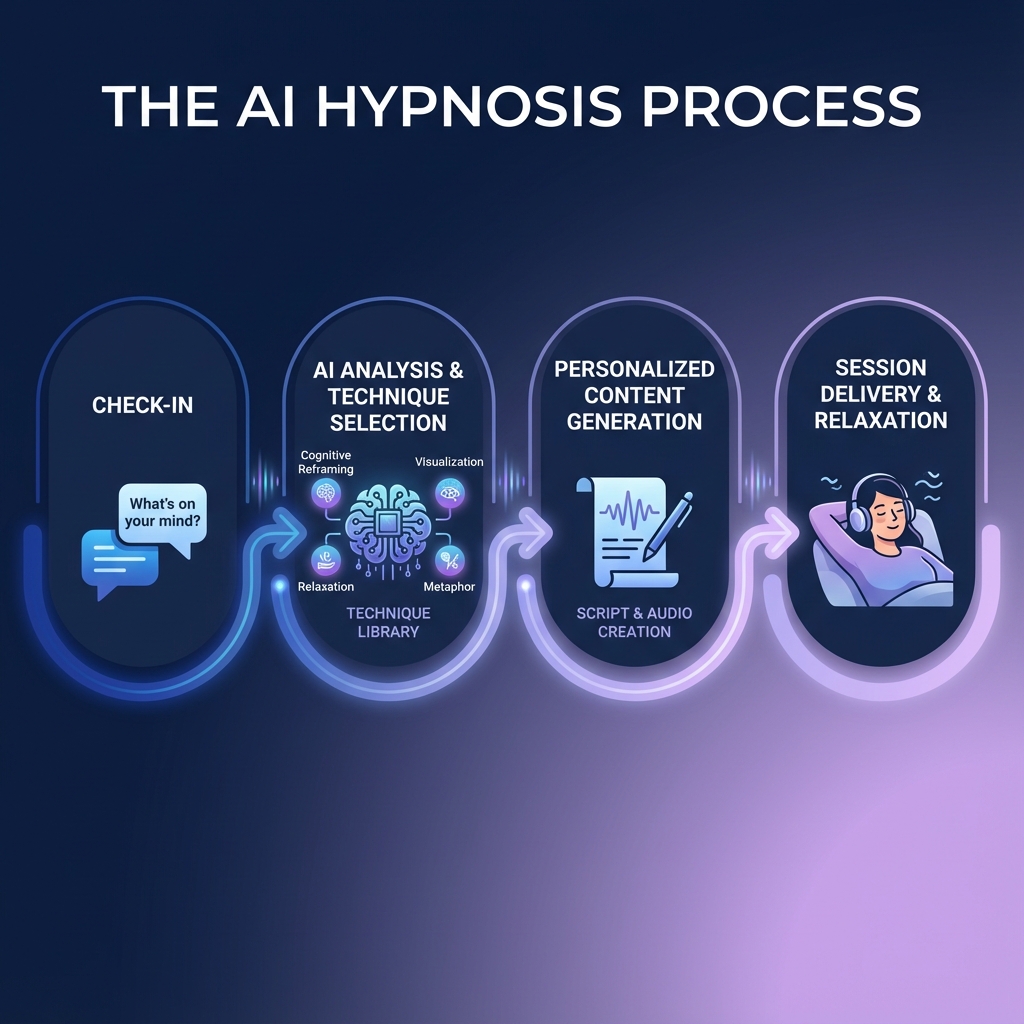
Step 3: Voice synthesis
The generated script needs to become audio you can listen to.
This is where AI voice technology comes in. Modern text-to-speech systems produce remarkably natural voices — warm, calm, with appropriate pacing and emphasis.
At InTheMoment, you can choose from different voices. The AI voice technology applies consistent delivery, proper pacing for hypnosis (which requires slower, more deliberate speaking), and appropriate intonation.
The result is audio that sounds like a skilled hypnotherapist reading a script written specifically for you.
Step 4: The session itself
When you listen to the session, several things happen:
Physical relaxation. The induction phase systematically relaxes your body. This isn’t optional — physical relaxation triggers mental relaxation. Your nervous system shifts from sympathetic (alert, stressed) to parasympathetic (calm, receptive).
Narrowed attention. You’re guided to focus on the voice, perhaps on your breathing or sensations in your body. This narrowed attention is the hallmark of hypnotic states.
Absorptive focus. As you relax and focus, you may notice the outside world fading slightly. This is normal. You’re becoming absorbed in the experience.
Suggestion delivery. In this receptive state, the personalised suggestions are delivered. Your visualisation abilities are heightened. The scenarios feel more real.
Mental rehearsal. You might vividly imagine yourself in the interview, feeling calm and prepared. This isn’t just thinking about it — it’s experiencing it in a way that resonates with your subconscious.
Integration. The session ends by helping you bring these new patterns into waking life. Post-hypnotic suggestions link the relaxed, confident state to triggers (like seeing the interview door).
Step 5: Feedback and learning
After the session, you can provide feedback:
- “The visualisation of the interview room was really vivid.”
- “I felt like the relaxation phase was a bit rushed.”
- “The suggestions about remembering past successes really helped.”
This feedback directly influences future sessions. The system learns:
- Which techniques work for you
- What pacing suits you
- What language resonates
- What to emphasise or de-emphasise
Over time, your sessions become increasingly tuned to your preferences.
The learning mechanism
How does hypnosis actually change anything?
Our brains have plasticity — they’re constantly rewiring based on experience. Strong experiences leave stronger imprints.
When you vividly imagine yourself in a situation, your brain processes it similarly to actually being there. Neuroimaging studies show that imagined experiences activate many of the same brain regions as real experiences.
By repeatedly visualising a confident interview, you’re essentially giving your brain practice experiences. Each mental rehearsal strengthens the neural pathways for calm, confident responding.
It’s the same principle behind sports psychology. Athletes visualise successful performances because it genuinely improves their actual performance.
Hypnosis amplifies this effect by:
- Creating a relaxed state where imagination is more vivid
- Focusing attention so the experience feels more real
- Bypassing conscious skepticism that might diminish the effect
- Using suggestion to direct the experience toward specific outcomes
Why AI personalisation matters
Generic hypnosis recordings can help, but personalisation amplifies effectiveness.
Relevance increases engagement. When the content matches your exact situation, you’re more engaged. Higher engagement means deeper absorption.
Specificity improves visualisation. Imagining “your interview tomorrow” is more vivid than imagining “an interview someday.” The AI creates content for your situation.
Context-awareness prevents jarring moments. The session won’t assume you’re in a quiet room if you mentioned you’re on a train. Mismatched content breaks the trance.
Learning compounds over time. Each session builds on your feedback and history. The system gets better at reaching you specifically.
The safety layer
AI systems require guardrails. For hypnosis, this means:
Established techniques only. The AI doesn’t invent novel hypnotherapy methods. It applies proven techniques that have been used safely for decades.
Permissive language. Suggestions are framed as invitations, not commands. “You might notice feeling calm” rather than “You WILL feel calm.” This respects your autonomy.
Appropriate scope. AI hypnosis focuses on suitable self-help goals — confidence, stress, sleep, habits. It doesn’t attempt to treat clinical conditions that require professional care.
User control. You can open your eyes, end the session, move around, or reject any suggestion at any time. Hypnosis requires willing participation.
Limitations of the technology
Being honest about what AI hypnosis can’t do:
It can’t read minds. The AI only knows what you tell it. Vague check-ins produce generic sessions.
It can’t replace therapy. For trauma, severe mental health conditions, or complex psychological issues, work with a qualified professional.
It can’t guarantee results. Individual responses to hypnosis vary. Some people are more hypnotically responsive than others.
It’s technology-dependent. You need a device, internet connection, and audio output. It’s not suitable for all situations.
The complete picture
AI hypnosis combines:
- Psychology: Leveraging how brains learn through experience and imagination
- Natural language processing: Understanding your situation from conversational check-ins
- Content generation: Creating personalised scripts from established techniques
- Voice synthesis: Turning scripts into natural, calming audio
- Machine learning: Improving over time based on your feedback
None of these components is magical. Each is well-understood technology or psychology applied thoughtfully.
Together, they create something new: personalised hypnotherapy available on demand.
Is it real?
A fair question. Here’s my answer:
The hypnotic state is real. It’s been studied extensively. Brain scans show distinct patterns during hypnosis.
The therapeutic effects are real. Research supports hypnosis for various applications — pain management, anxiety, habit change.
The personalisation benefit is real. Relevance increases engagement, and specific content enables more vivid visualisation.
Whether AI hypnosis works for you specifically — that you can only discover by trying.
Curious to experience how it actually works? Get started with two free sessions per day — try it yourself.