“Should I try meditation or hypnosis?”
It’s a common question, and the answer isn’t always obvious. Both involve relaxation, both use similar techniques, and both claim mental health benefits. What’s actually different?
At InTheMoment, we offer both AI meditation and AI hypnosis. After watching thousands of people use each, I’ve developed a clear view of when each approach shines.
The fundamental difference
Here’s the key distinction:
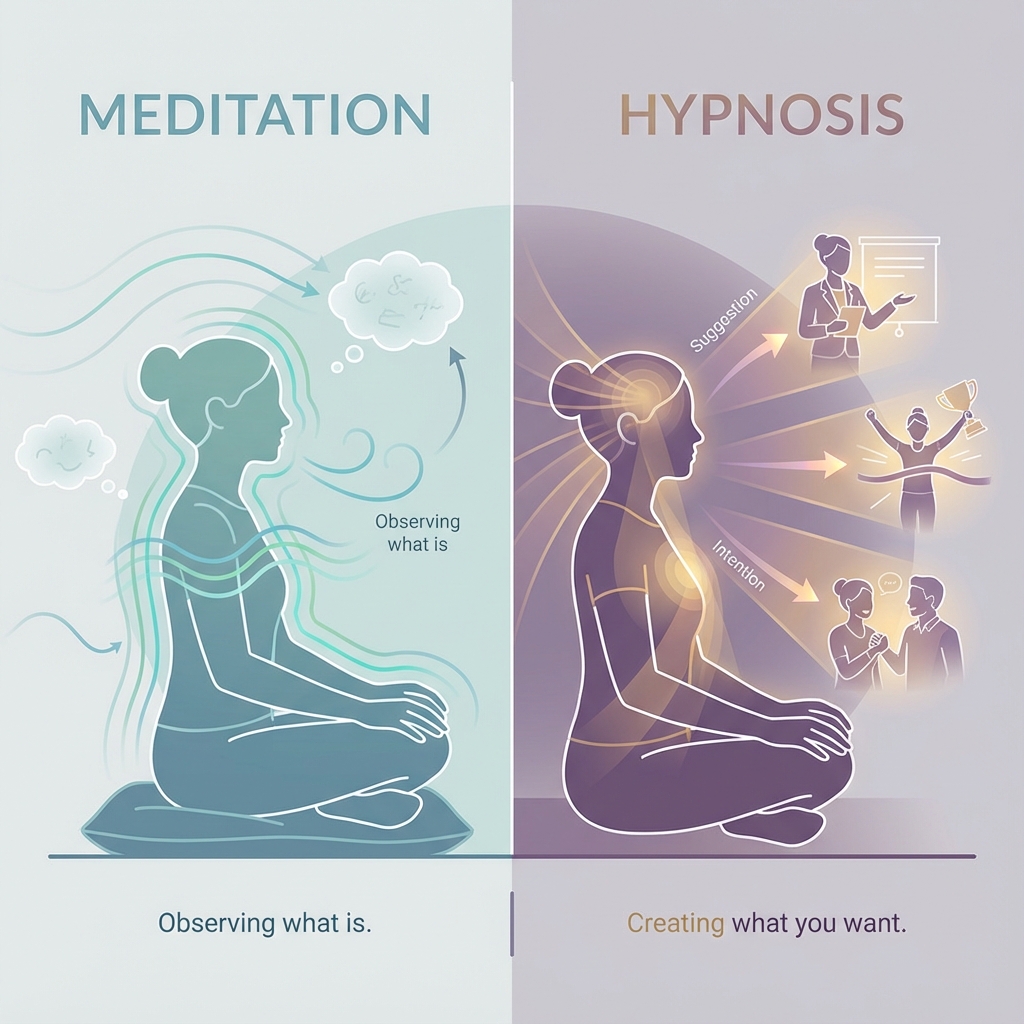
Meditation is about observing the present moment. You notice your thoughts, feelings, and sensations without trying to change them. The goal is awareness and acceptance.
Hypnosis is about directing change. You’re guided to imagine new patterns, rehearse desired outcomes, and plant suggestions. The goal is influence over subconscious processes.
Another way to frame it:
- Meditation asks: “What is here right now?”
- Hypnosis asks: “What do you want to create?”
Both involve focused attention and relaxation. But the direction is different — one is receptive, one is directive.
How they feel different
When meditating, you might:
- Focus on your breath, noticing each inhale and exhale
- Observe thoughts arising and passing
- Scan your body, noticing sensations without judgment
- Rest in open awareness, present to whatever arises
When in hypnosis, you might:
- Visualise yourself in a specific situation, feeling confident
- Mentally rehearse a conversation going well
- Receive suggestions about how you’ll feel in the future
- Imagine your life without a problematic habit
The internal experience differs. Meditation often feels spacious and accepting. Hypnosis often feels more active and imaginal.
Different applications
This points toward different use cases.
Meditation is particularly good for:
Daily maintenance. Regular meditation builds a baseline of calm and awareness that carries through daily life.
Processing the present. When something is happening now — stress, difficult emotions, a busy mind — meditation helps you be with it.
Building mindfulness. The capacity to notice your thoughts and choose your response rather than react automatically.
General wellbeing. Long-term meditation practice is associated with reduced stress, improved focus, and better emotional regulation.
Hypnosis is particularly good for:
Specific goals. When you want to change something — build confidence, quit smoking, sleep better — hypnosis targets that directly.
Future preparation. Before an interview, a presentation, a difficult conversation — hypnosis helps you mentally rehearse success.
Changing patterns. Habits, automatic responses, ingrained beliefs. Hypnosis works at the level where these operate.
Performance enhancement. Athletes use mental rehearsal for a reason. Hypnosis is essentially structured mental rehearsal.
Different mechanisms
Understanding how each works helps clarify the difference.
Meditation works by:
Training attention. Repeatedly returning to the breath builds the capacity to focus.
Building equanimity. Observing difficult experiences without reacting reduces emotional reactivity.
Creating space. The gap between stimulus and response widens. You have more choice.
Shifting perspective. Regular Practice reveals the transient nature of thoughts and feelings.
Hypnosis works by:
Accessing the subconscious. In the relaxed state, suggestions reach below conscious filters.
Creating “experiences.” Vivid visualisation is processed similarly to actual experience.
Installing new associations. Triggers become linked to different responses.
Reinforcing identity. You experience yourself as the person you want to become.
They’re complementary, not competing
At InTheMoment, many users do both. Here’s a common pattern:
Morning: Brief meditation session to start the day centred.
Before challenges: Hypnosis session to prepare for an interview, presentation, or difficult situation.
Evening: Meditation to process the day and transition to rest.
For specific goals: Hypnosis sessions focused on habit change, confidence, or sleep.
The combination works well. Meditation builds the foundation — sustained attention, emotional stability, present-moment awareness. Hypnosis targets specific changes within that foundation.
What if you’re new to both?
If you’ve never tried either, here’s my suggestion:
Start with meditation if:
- You’re generally curious about mindfulness
- You want to build a daily practice
- You’re dealing with stress or anxiety without a specific goal
- You want to observe and understand your mind
Start with hypnosis if:
- You have a specific goal (quit smoking, build confidence, etc.)
- You’re preparing for a specific event
- You want to change a habit
- You’re comfortable relaxing and letting your imagination lead
Neither is “harder” or more “advanced.” They’re different tools for different purposes.
The overlap
Despite the differences, there’s significant overlap:
Relaxation. Both start with relaxation. A calm body enables a focused mind.
Focused attention. Both require attention — whether on breath or on visualisation.
Altered state. Both can produce shifts in awareness — the sense of time changing, the world feeling further away.
Guidance. In guided forms, both involve following a voice’s instructions.
Some practices blur the line. A “visualisation meditation” uses imagination (more like hypnosis). A “awareness hypnosis” emphasises observation (more like meditation).
The categories are useful but not rigid.
Which one for stress and anxiety?
Both help with stress and anxiety, but differently:
Meditation helps you be with anxiety. Observe it without fighting. Notice the physical sensations. Let it be present without reacting.
Hypnosis helps you reduce anxiety. Rewire the stress response. Build relaxation triggers. Mentally rehearse calm responses.
For ongoing anxiety management, I’d suggest meditation as the foundation — building your capacity to be with difficult experiences.
For acute situations or specific anxieties (public speaking, social situations), hypnosis can directly address the pattern.
Which one for sleep?
Both work for sleep, but again differently:
Meditation before sleep helps the mind settle. You’re not trying to force sleep — you’re creating conditions where it naturally arises.
Hypnosis for sleep actively induces the transition. Progressive relaxation deepens into sleep. Suggestions about sleeping deeply take hold.
Many people find hypnosis more effective for actually falling asleep — the directive nature guides you toward sleep rather than just being present with wakefulness.
Which one for performance?
For performance — interviews, presentations, athletic endeavours, creative work:
Hypnosis is typically better. Mental rehearsal is the core of performance psychology. Visualising success, building confidence, preparing for specific scenarios — this is what hypnosis excels at.
Meditation can help you be present during performance, but hypnosis helps you prepare for it.
The bottom line
Meditation and hypnosis are both valuable. They serve different purposes.
Meditation: Observe, accept, be present. Best for general wellbeing and processing what is.
Hypnosis: Direct, change, influence. Best for specific goals and creating what you want.
Neither is better. The right choice depends on what you need.
At InTheMoment, both are available, both are AI-personalised, and both work within the same system. Try each. See what resonates.
The mind responds to both tools. Use the one that fits your current need.
Want to explore both? Get started with two free sessions per day — try meditation and hypnosis to see which works for you.