How you start the day shapes everything that follows.
Start with email, and you’re reactive. Start with news, and you’re anxious. Start with social media, and you’re scattered.
Start with meditation, and you’re grounded.
Morning meditation is the most impactful time to practice. Here’s how to build a morning routine that sticks.
Why morning works best
Several factors make morning meditation particularly powerful:
Clean slate. Your mind hasn’t accumulated the day’s concerns yet. There’s less to settle.
Willpower reserves. Decision-making capacity is highest in the morning. It’s easier to do the practice.
Guaranteed time. Morning is before the day’s chaos. It’s reliably available if you make it so.
Sets the tone. How you start influences what follows. Starting mindfully carries forward.
Habit anchoring. Morning routines are stable. Practice attached to morning activates reliably.
Research confirms practitioners find morning practice easier to maintain than evening practice.
The basic morning routine
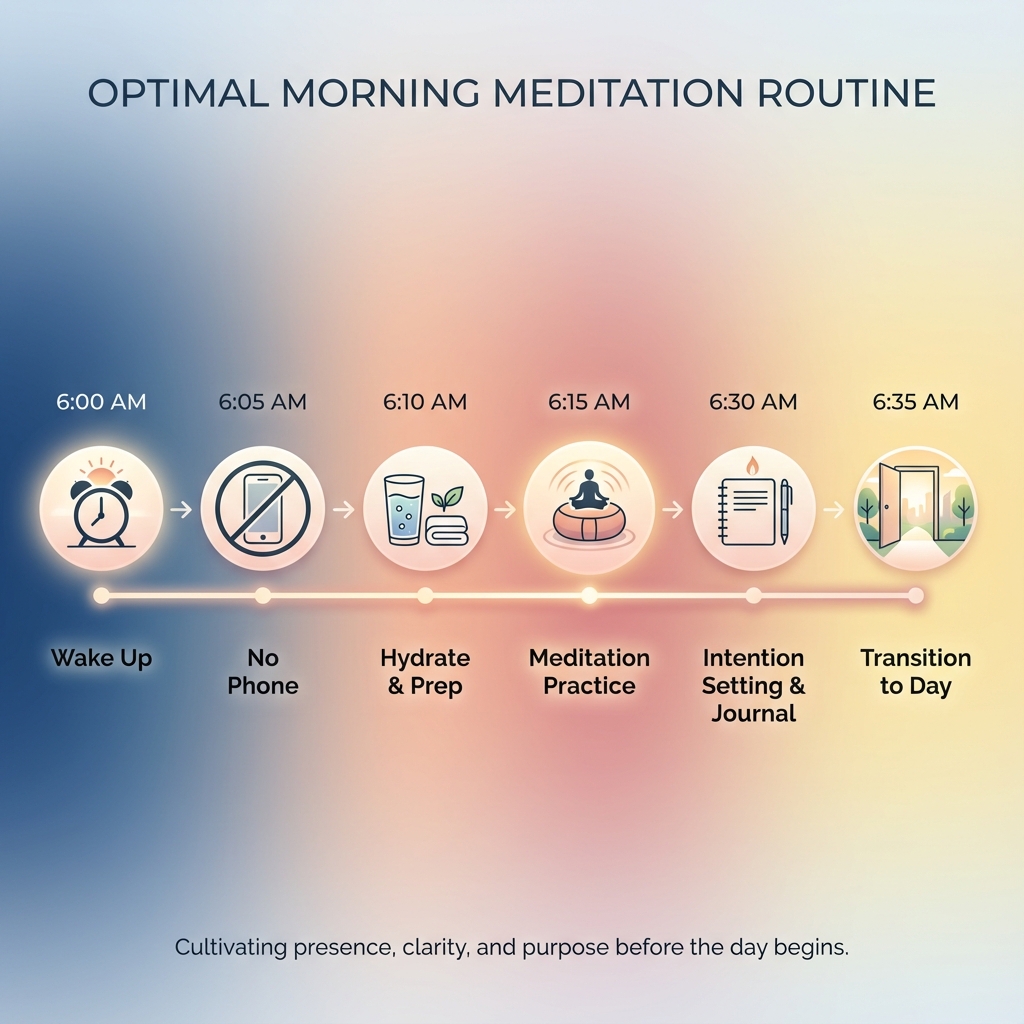
A simple, effective morning meditation routine:
1. Wake up. (Obviously.) Perhaps with a gentle alarm rather than jarring noise.
2. Avoid phone. This is crucial. Don’t check anything before practice. The phone activates reactive mind.
3. Brief body preparation. Bathroom, splash water on face if needed, perhaps a drink of water.
4. Sit for meditation. A consistent spot. The same chair or cushion each day.
5. Practice. 10-20 minutes of guided meditation.
6. Gradual transition. Don’t immediately grab the phone. Take a moment to set intention for the day.
7. Then continue the morning. Coffee, breakfast, whatever follows.
Total added time to morning: 15-25 minutes. Significant impact, modest time investment.
What AI meditation adds to the morning
AI meditation enhances morning routine:
Fresh content daily. Each morning session is different. No repetition boredom.
Check-in acknowledges where you are. Some mornings you’re alert; others, groggy. The session adapts.
Intention-setting. AI can incorporate your day’s challenges. “I have a difficult meeting today” shapes content.
Variety of techniques. Sometimes breath focus. Sometimes body scan. Sometimes gratitude. The AI varies appropriately.
Energy-appropriate. Morning sessions can be gently energising rather than deeply relaxing. Setting up for active day.
Building the habit
The morning meditation habit requires protection:
Prepare the night before
- Set out meditation space
- Charge phone elsewhere (so it’s not bedside)
- Know what you’re wearing (reduce morning decisions)
Anchor to existing habit
Attach meditation to something already automatic:
- After using bathroom
- Before coffee
- After brushing teeth
The existing habit triggers the new one.
Make it non-negotiable
Morning meditation is like brushing teeth — you just do it. Not something decided daily.
Even when tired. Even when busy. Even when not in the mood.
The decision is already made.
Protect the time
This might mean:
- Waking 15-20 minutes earlier
- Simplifying other morning activities
- Preparing evening routines the night before
Something may need to adjust. Meditation becomes a priority.
Sample morning routines
Minimal (15 minutes total)
5:00 - Wake, bathroom
5:05 - 10-minute meditation
5:15 - Continue day
For those with extremely tight mornings.
Standard (30 minutes total)
6:00 - Wake
6:05 - Brief stretching
6:10 - 15-minute meditation
6:25 - Set intention for day
6:30 - Continue morning routine
A balanced approach for most people.
Extended (60 minutes total)
5:30 - Wake
5:35 - Morning journaling (5-10 min)
5:45 - 20-minute meditation
6:05 - Light movement or yoga (15 min)
6:20 - Intention and planning (10 min)
6:30 - Begin day
For those prioritising morning well-being.
Weekend (45 minutes)
No alarm wake
Morning hydration
20-30 minute deeper meditation
Leisurely transition to day
Longer practice when schedule allows.
When morning is genuinely impossible
Some life situations make true morning practice hard:
New parents: Sleep is already fragmented. Don’t add pressure.
Night shift workers: Your “morning” is different. Adapt to your schedule.
Shared space constraints: If you can’t have quiet, consider audio with headphones.
In these cases:
- Find the first available consistent window in your schedule
- Start with minimal duration (5 minutes)
- Be patient with the process
Something is always better than nothing.
The no-phone rule
The most important morning habit: don’t touch your phone before meditation.
When you check the phone:
- Email introduces tasks and stress
- News triggers anxiety
- Social media scatters attention
- Everything shifts to reactive mode
The phone can wait 20 minutes. It really can.
If you use your phone for mediation audio, set it to airplane mode. No notifications.
Morning meditation vs evening
Comparison of different timing:
| Factor | Morning | Evening |
|---|---|---|
| Mind state | Cleaner, less accumulated | Busier, more to process |
| Energy | Generally higher | Often tired |
| Habit reliability | Very high | Variable |
| Function | Sets up day | Processes day |
| Challenge | Waking earlier | Competing with fatigue |
Morning is generally easier to maintain. But some people genuinely prefer evening. Know yourself.
What if you miss a morning?
You will miss mornings. Travel, illness, irregular schedules, oversleeping.
When you miss:
Don’t add guilt. Just missed practice, not moral failure.
Consider quick catch-up. 5 minutes later in day is better than nothing.
Return next morning. One miss doesn’t break the habit if you return immediately.
Notice patterns. Repeated misses suggest something needs changing.
The compound effect
Morning meditation compounds:
- Each day is slightly more grounded
- Each week, the habit strengthens
- Each month, the calm baseline rises
- Each year, the practice becomes identity
After a few months, you’ll wonder how you ever started days without this.
The mornings add up. The person who has meditated every morning for a year is different from the person who hasn’t.
Beyond meditation
A complete morning routine might include:
- Movement - Stretching, yoga, or exercise
- Journaling - Processing thoughts on paper
- Planning - Setting day’s priorities
- Gratitude - Noting what you appreciate
- Reading - Non-news, nourishing content
Meditation is often the core, with other elements added.
Start with meditation alone. Add other elements once the habit is solid.
Getting started tomorrow
Don’t overthink this:
Tonight: Set your alarm 15 minutes earlier. Put phone where it can’t be checked from bed.
Tomorrow: Wake. Brief bathroom visit. Sit. Open the app. 10-minute session. Done.
Then: Repeat.
That’s it. Not complex. Just consistent.
Start tomorrow. The morning meditation routine that changes your life begins with one morning.
Ready to transform your mornings? Get started with two free sessions per day — begin each day grounded and clear.