For years, I thought anxiety was something happening in my head.
Worried thoughts leading to more worried thoughts. A mental problem requiring a mental solution.
But my therapist suggested something different: “What’s happening in your body right now?”
Tight chest. Clenched jaw. Shallow breathing. Racing heart. The thoughts were there too, but the body was reacting first.
That’s when I started learning about the autonomic nervous system — and why “just calm down” is terrible advice.
Your nervous system isn’t optional
Here’s the basic picture:
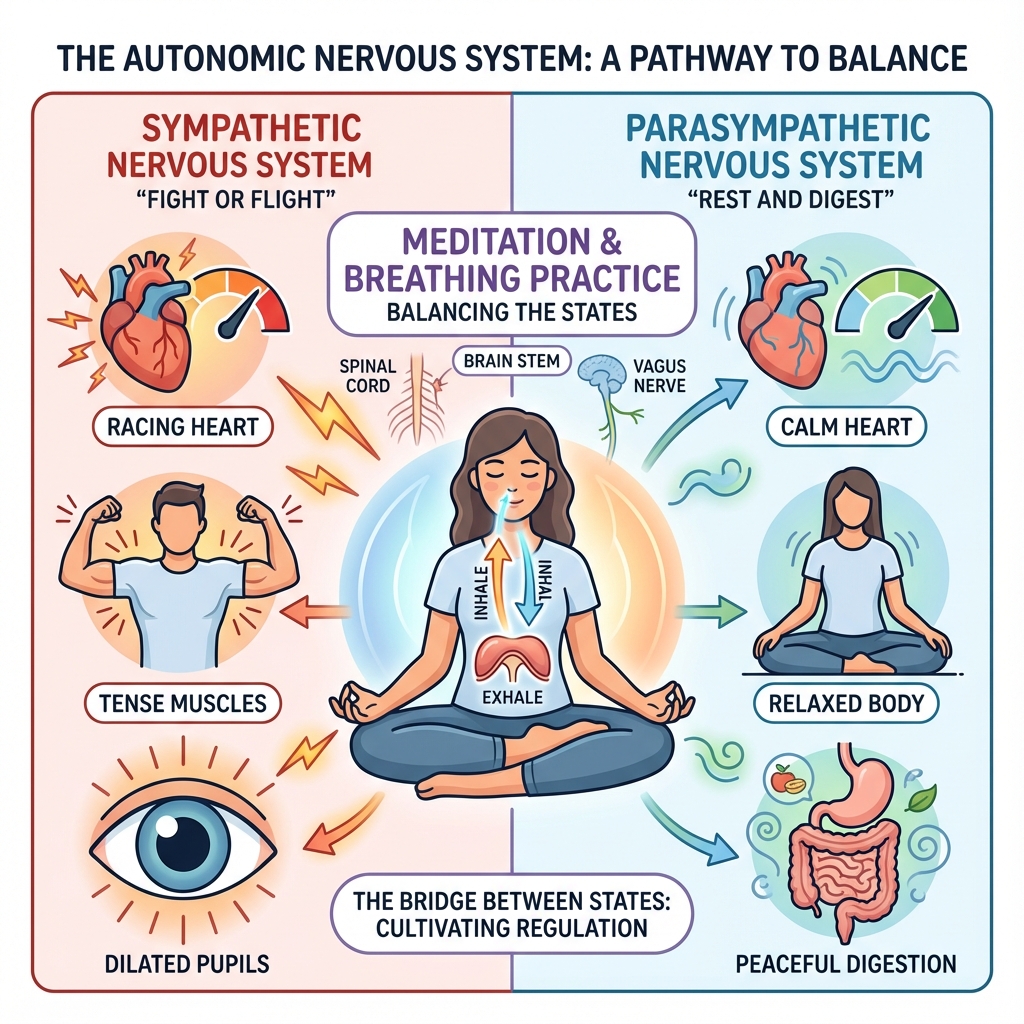
Your autonomic nervous system runs constantly in the background, regulating things you don’t consciously control: heart rate, digestion, breathing, sweating, arousal.
It has two main branches:
Sympathetic: The accelerator. Activated when you perceive threat. “Fight or flight.” Increases heart rate, diverts blood to muscles, sharpens focus, prepares for action.
Parasympathetic: The brake. Activated when you perceive safety. “Rest and digest.” Slows heart rate, promotes digestion, allows repair and recovery.
Here’s the crucial part: these systems run based on perceived threat and safety. Perception, not reality.
Your nervous system can’t tell the difference between a tiger chasing you and a difficult email. Both can trigger the sympathetic response. Both can flood you with adrenaline and cortisol.
For many of us, the accelerator is stuck down.
Why your system might be dysregulated
Modern life is a nervous system nightmare.
We evolved for acute stressors: occasional predators, brief conflicts, physical challenges. Bursts of activation followed by recovery.
What we get instead: constant low-grade stress. Always on. Always reachable. Always something demanding attention or triggering concern.
The result is a nervous system that never fully returns to baseline. Always slightly activated. Never fully resting.
Signs of dysregulation:
- Trouble sleeping even when tired
- Easily startled or irritated
- Difficulty relaxing even without external demands
- Digestive issues
- Chronic muscle tension
- Racing thoughts that won’t stop
- Feeling wired but exhausted
If this sounds familiar, your system might need help finding its way back to calm.
What meditation actually does (physiologically)
When I first learned about the nervous system, I understood why meditation works — beyond all the vague talk about “mindfulness” and “presence.”
Meditation directly activates the parasympathetic system.
Slow breathing. When you slow your exhale longer than your inhale, it activates the vagus nerve — a major parasympathetic pathway. Your heart rate decreases. Your system gets the message: “safe.”
Stillness. Physical stillness signals that there’s no need to prepare for action. The body downshifts.
Focused attention. When attention is on one thing (breath, body, a mantra), the system isn’t scanning for threats. Vigilance decreases.
Interoceptive awareness. Noticing body sensations activates brain regions involved in self-regulation. You become better at reading your own internal state.
It’s not magic. It’s nervous system training.
Why “just calm down” doesn’t work
If your nervous system is in sympathetic activation, you can’t think your way to calm.
Telling yourself to relax is like trying to slow your heart by wishing. The system doesn’t take orders from your conscious mind.
What it does respond to:
- Changed breathing patterns
- Physical stillness
- Repeated signals of safety
- Gradual habituation
This takes time and practice. You’re literally training your nervous system to recognise safety, and that recognition builds through repetition.
Meditation isn’t about forcing calm. It’s about creating conditions where calm can emerge.
Practical techniques that work
Extended exhale breathing
The simplest way to activate parasympathetic response:
- Inhale for 4 counts
- Exhale for 6-8 counts
The extended exhale stimulates the vagus nerve. Do this for a few minutes and you’ll feel the shift.
Body-based grounding
When activated, attention tends to be in the head — racing thoughts, catastrophising.
Bringing attention to the body interrupts this:
- Feel your feet on the floor
- Notice your hands resting
- Sense the contact between your body and the chair
Physical grounding signals safety.
Slow, gentle movement
In acute activation, sitting still can feel impossible.
Gentle movement — slow stretching, swaying, or walking — can help discharge activation enough that you can then be still.
Temperature regulation
Splashing cold water on your face activates the “dive reflex,” which slows heart rate. This is a physiological hack used for panic.
Consistent daily practice
More than any single technique: regular meditation trains your system toward resilience.
The cumulative effect of daily sitting is a nervous system that returns to baseline faster, activates less intensely, and tolerates discomfort better.
My experience with regulation
I used to be continuously slightly activated. Not full panic, but never fully calm. A hum of anxiety always present.
Regular meditation has changed my baseline.
The thoughts still arise. Anxious scenarios, worried narratives, worst-case thinking. But the body doesn’t react as strongly. The physiological cascade is less intense.
It’s like the threshold for activation has risen. Things that used to flood me now register as minor ripples.
I still get anxious. But I recover faster. And I recognise what’s happening — “oh, my nervous system is doing the thing” — rather than being completely at its mercy.
AI meditation for nervous system support
What I appreciate about AI meditation is that it can adapt to my current state.
If I tell InTheMoment that I’m activated and anxious, the session emphasises grounding, extended exhale, and body-based techniques.
If I’m already relatively calm and want to build capacity, the session might be different — more exploratory, less focused on immediate regulation.
The system creates sessions based on what you’re dealing with right now, rather than offering generic content that may or may not match your state.
Two free sessions per day. Tell it you want to work on nervous system regulation and see what it creates.
Beyond meditation
Meditation is powerful, but it’s not the only nervous system tool.
Movement. Exercise discharges stress hormones. Walking, running, stretching — all help reset the system.
Social connection. Co-regulation with other calm, safe people. The nervous system responds to other nervous systems.
Nature. Something about natural environments signals safety to the mammalian brain.
Sleep. Chronic sleep deprivation keeps the system in high alert. Rest is non-negotiable.
Boundaries. Saying no to things that chronically activate you. Removing stressors where possible.
Meditation fits within this ecosystem, not as a replacement for other supports.
What regulated feels like
For a long time, I didn’t know what a regulated nervous system felt like.
Here’s my experience now:
- Genuinely resting when resting, rather than rest-while-still-alert
- Challenges creating temporary activation that then resolves, rather than permanent baseline elevation
- Body feeling comfortable rather than perpetually tense
- Mind able to focus because it’s not constantly scanning for threats
- Sleep coming naturally rather than being chased
I’m not there all the time. Stress still happens. But the direction is right, and the baseline has shifted.
You can train your nervous system. It takes time and consistency, but the change is real.
Want meditation that works with your nervous system? Get started with two free sessions per day — tell us how you’re feeling and the session adapts.