If you’ve stumbled across the term “AI meditation” and aren’t quite sure what it means, you’re not alone. It’s a relatively new concept, and frankly, it sounds a bit contradictory at first. Meditation is supposed to be ancient and human. AI is… decidedly not.
But bear with me. Once I understood what AI meditation actually was, it completely changed my relationship with meditation practice.
The simple explanation
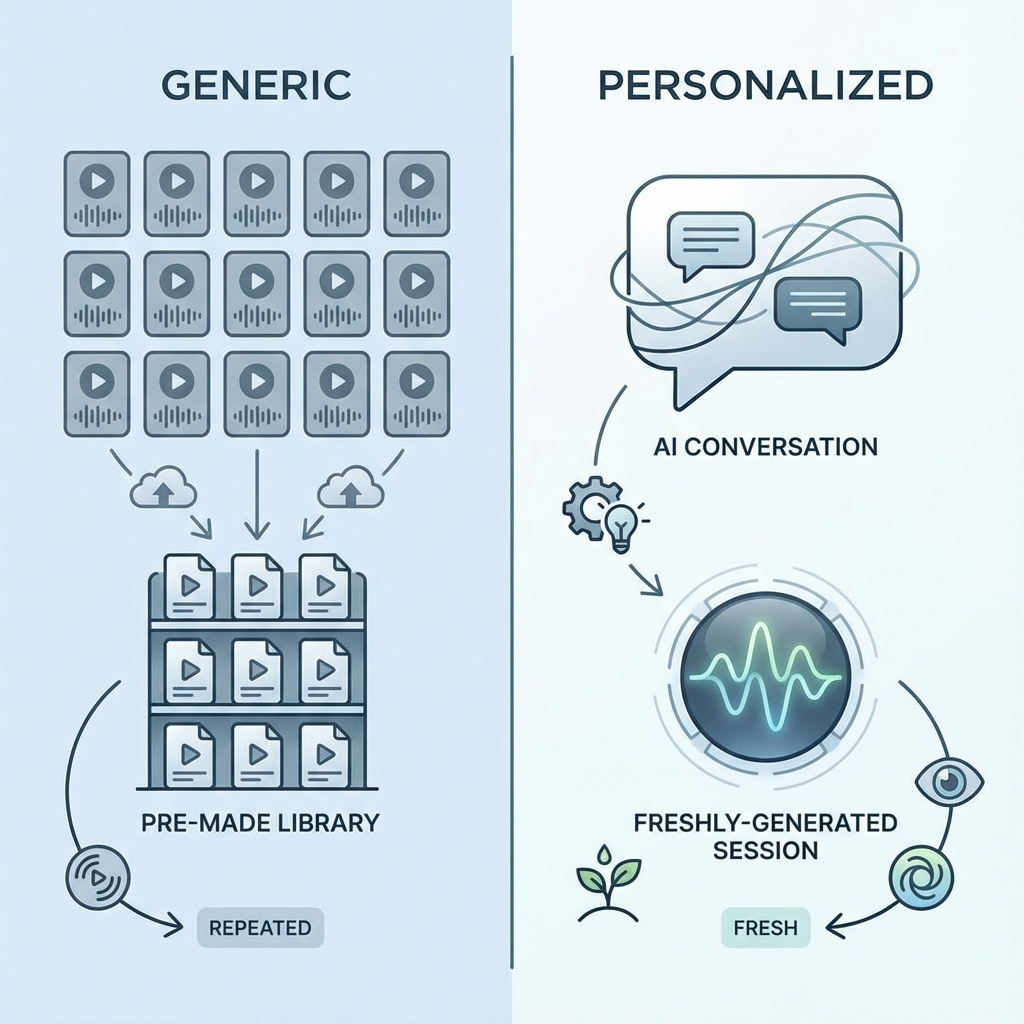
AI meditation is guided meditation where the content is created by artificial intelligence, specifically for you, in the moment.
That’s it. Instead of pressing play on a pre-recorded session that was made months ago for a general audience, you get a session that was just created, right now, based on your current situation.
Think of it like the difference between a generic motivational poster and a conversation with a close friend. Both might contain wisdom, but one knows your actual context.
How traditional meditation apps work
Before we go further, it’s worth understanding the alternative. Apps like Headspace and Calm work by offering a library of pre-recorded sessions. Experts record content on topics like stress, sleep, focus, or general mindfulness. You browse the library, pick something that sounds relevant, and press play.
This approach has clear advantages:
- The content is crafted by meditation teachers
- It’s polished and professionally produced
- It’s been tested on millions of users
But it also has limitations:
- The session doesn’t know anything about your actual day
- The techniques might not fit your physical situation
- The teaching might feel disconnected from what you’re actually dealing with
I used Headspace for years, and I genuinely loved it. But I found myself drifting away from practice because the sessions started feeling… generic. Like reading a horoscope that could apply to anyone.
How AI meditation is different
AI meditation flips this model. Instead of pre-recording content, it creates each session fresh.
Here’s how it typically works with InTheMoment:
1. You have a short conversation. Before your session, you chat briefly about what’s on your mind. What are you doing right now? How are you feeling? What’s happening in your life? Think of it like catching up with a friend — you can go as light or as deep as you want.
2. The AI creates a session. Based on your conversation, the system creates a meditation session tailored to your specific moment. It chooses teachings that are relevant to what you’re dealing with, and techniques that fit your environment and posture.
3. You listen and practice. The session is delivered in a professional voice with ambient audio. It feels like a normal guided meditation, except the content is speaking directly to your situation.
4. You provide feedback. After listening, you can share what worked and what didn’t. This feedback carries forward, so future sessions get increasingly tuned to your preferences. We explain how AI personalises your practice in more detail.
A real example
Let me give you a concrete scenario.
You’re on the train in the morning, heading into work. There’s a presentation you’re slightly nervous about. You’re not exactly anxious, but there’s that familiar low-level buzz of anticipation.
With a traditional app, you might search for “presentation anxiety” or “morning calm.” Maybe you find something, maybe you don’t. Either way, the session probably tells you to sit comfortably with your eyes closed — which isn’t really an option on a packed commuter train.
With AI meditation, you type: “On the train. Got a presentation later. Feeling a bit buzzy.”
The session that comes back understands you’re on a train (no “listen to the sounds of your room”). It understands you’re not full-on anxious, just alert. And it focuses on helping you channel that energy productively rather than trying to eliminate it entirely.
That’s the difference. The meditation meets you where you actually are, not where a recorded session assumes you might be.
But can AI really teach meditation?
This was my biggest concern too. Meditation has been passed down through traditions for thousands of years. Can an algorithm really capture that wisdom?
Here’s the thing I learned: AI meditation doesn’t invent techniques. In the same way that personal trainers don’t create exercises, and personal tutors don’t invent knowledge — AI meditation doesn’t make up meditation practices.
Instead, it draws from established methods. Breath awareness, body scans, visualisation, loving-kindness practice — these are all real techniques with real histories. The AI’s job is to select the right technique for your situation and deliver it in a way that resonates with you.
At InTheMoment, we take this a step further. Our sessions are built on a foundation of real meditation literature, not just generated freestyle. The AI picks from a range of established techniques and applies them contextually. This prevents the system from “hallucinating” teachings that sound good but have no grounding in actual practice.
Who is AI meditation for?
Honestly? Not everyone.
If you’re completely new to meditation and want structured teaching from a human expert, a traditional app might be better to start. There’s real value in following a designed course that builds concepts gradually.
But AI meditation shines in specific situations:
If you’ve tried meditation before but couldn’t stick with it. The personalisation removes friction. When sessions feel relevant, practice feels worthwhile.
If your life is dynamic and unpredictable. Travelling, irregular schedules, changing circumstances — AI meditation adapts to all of it.
If you want meditation that integrates with real life. Instead of carving out special “meditation time,” you can practice during a walk, on your commute, even while doing light stretching.
If you’ve outgrown beginner content. Once you know the basics, you might want sessions that push deeper based on where you actually are in your journey.
The limitations (being honest)
AI meditation isn’t perfect. Here are the genuine downsides:
It requires typing or speaking. The check-in conversation adds time compared to just pressing play. Usually it’s about five exchanges, so maybe 2-3 minutes extra.
The quality depends on your input. If you give vague context, you get generic sessions. The more you share, the better the personalisation.
It’s technology, not a human. Some people want to feel connected to a specific teacher with a specific philosophy. AI can simulate teaching, but it can’t replace genuine human presence.
Internet connection required. Unlike downloaded sessions, AI meditation typically needs connectivity to generate content.
Structuring AI meditation practice
One concern I had initially was structure. With traditional apps, you follow courses. Lesson one builds on lesson zero. There’s progression.
Can AI meditation offer the same?
The answer is a qualified yes. The approach we’ve taken at InTheMoment involves two elements:
Session context. Each new session has access to summaries of your previous sessions — the teachings explored, the techniques used, and any feedback you provided. This creates continuity even in freeform practice.
Courses. For those who want structure, we offer curated courses. These are like curriculums. Each session within a course has a defined focus — written by humans, grounded in real teachings. The AI then personalises the delivery while keeping the core content consistent.
So you can go fully freeform, following where your life takes you. Or you can follow a structured path while still getting sessions that adapt to your environment.
Is it worth trying?
If you’re curious, the barrier is low. Most AI meditation services, including ours, offer free sessions. You can try it without commitment and see if the approach resonates.
For me, AI meditation was the thing that actually made practice stick. Not because it’s objectively “better” than traditional apps — but because it fits my life. If you’re ready to try, our AI meditation beginner’s guide walks you through your first session. The sessions meet me where I am. The feedback loop means they keep getting better. And the variety means I never feel like I’m repeating the same generic content.
Maybe it’ll work for you. Maybe it won’t. But if you’ve tried meditation before and struggled to maintain it, this might be worth exploring. For the evidence behind the approach, read the science behind AI meditation.
The best meditation is the one you actually do. And AI meditation, by reducing friction and increasing relevance, makes practice a little easier to maintain.
Ready to try AI meditation yourself? Get started with two free sessions per day — no credit card required.