“Is this actually backed by science, or is it just wellness nonsense?”
Fair question. Meditation has been bundled with so many dubious claims over the years that scepticism is healthy. Add AI to the mix and it sounds even more like marketing speak.
So let’s look at what we actually know — both about meditation generally and about the specific value AI personalisation might add.
What research says about meditation
First, the good news: meditation is one of the most studied wellness practices in existence. It’s not fringe science. Thousands of peer-reviewed studies have examined its effects.
Here’s a summary of what the research consistently shows:
Reduced stress and anxiety. Multiple meta-analyses (studies of studies) have found that meditation reduces symptoms of anxiety and depression. The effect sizes are modest but meaningful — comparable to some medications, without the side effects.
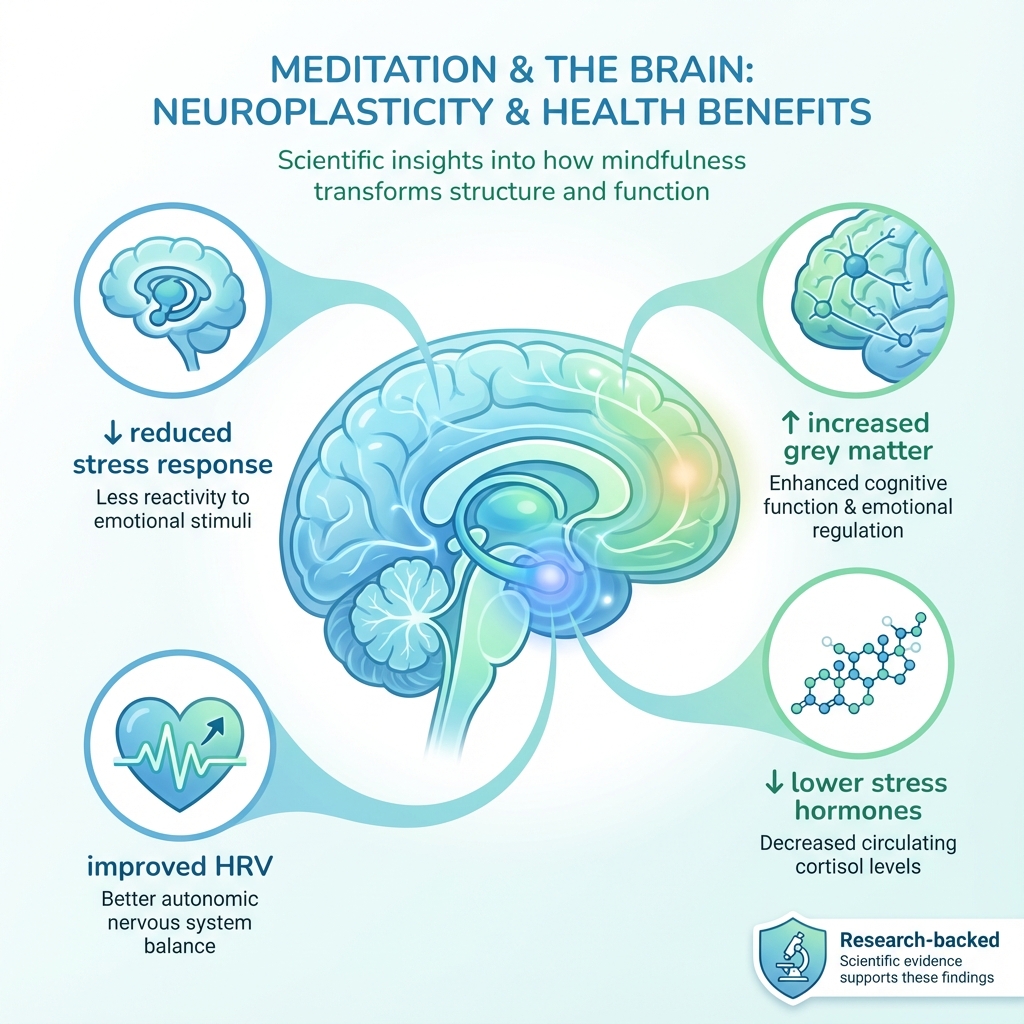
Changes in brain structure. Neuroimaging studies show that regular meditation practice physically changes the brain. The amygdala (involved in fear and stress responses) tends to show reduced activity. The prefrontal cortex (involved in emotional regulation) shows increased grey matter density.
Improved attention and focus. Studies consistently find that meditation improves the ability to sustain attention and resist distraction. This makes sense — meditation is fundamentally attention training.
Better emotional regulation. Meditators show improved ability to recognise, accept, and regulate their emotions. They’re less reactive to negative stimuli.
Physiological changes. Regular practice is associated with lower blood pressure, reduced cortisol levels, and improved heart rate variability (a marker of stress resilience).
None of this is controversial in scientific circles anymore. The debate isn’t whether meditation “works” — it clearly does something measurable. The debate is about which types of meditation work best, for whom, and how much practice is needed.
The challenge with traditional approaches
Here’s where it gets interesting for AI.
Most meditation research has a problem: the interventions are standardised. Everyone gets the same instruction. Everyone does the same type of practice.
But meditation is deeply personal. What works for one person might not work for another.
Consider two people with anxiety:
Person A finds body-focused practices helpful. When they scan their body and release tension, their mind calms.
Person B finds body-awareness triggering. Focusing on physical sensations increases their anxiety. They do better with loving-kindness or visualisation practices.
In a research study, both might be assigned the same intervention. Person A benefits. Person B doesn’t. The average effect is moderate.
But what if we could match people to practices that actually work for them?
This is the promise of AI meditation.
What personalisation adds
AI meditation doesn’t change the underlying techniques. Breath awareness is still breath awareness. Body scanning is still body scanning. These are established methods with evidence behind them.
What AI adds is fit.
At InTheMoment, before each session, you share context about your current state. What’s on your mind? How are you feeling? What’s your environment like? The AI then selects techniques that match.
Stressed about a specific situation? The session might focus on cognitive reframing — helping you see the situation from a different perspective.
Carrying tension in your body? Progressive muscle relaxation might be emphasised.
Mind racing with thoughts? Breath counting or open awareness might be chosen instead.
This isn’t AI inventing new techniques. It’s AI matching established techniques to individual needs.
The analogy we use is personal training. A personal trainer doesn’t invent exercises — they know which exercises from the established repertoire will help you specifically.
Does personalisation actually improve outcomes?
This is a fair question, and honestly, we don’t have the same mountain of peer-reviewed evidence for AI-personalised meditation that we have for meditation generally. The field is too new.
What we do have:
Evidence that personalisation works in other domains. Personalised medicine, personalised fitness, personalised learning — the principle that matching interventions to individuals improves outcomes is well-established across many fields.
User feedback. This is anecdotal, but meaningful. Users consistently report that AI meditation sessions feel more relevant and useful than generic sessions. Relevance correlates with engagement. Engagement correlates with consistent practice. Consistent practice is what generates benefits.
Theoretical plausibility. The mechanisms by which meditation works — attention training, emotional regulation, stress reduction — should all benefit from techniques that are better matched to individual needs.
Is this proof? No. But it’s a reasonable hypothesis, grounded in existing evidence.
The AI element: legitimate or gimmick?
Let me address the elephant in the room: is “AI” here just marketing, or does it genuinely add something?
Here’s how AI is actually used at InTheMoment:
Understanding context. The AI processes your check-in conversation to understand your current state. What are you feeling? What’s worrying you? What’s your physical environment? This is genuine natural language understanding.
Selecting techniques. Based on that understanding, the AI selects from a library of established meditation and hypnosis techniques. It’s not making things up — it’s choosing from proven methods.
Personalising delivery. The session script is generated to fit your specific situation. If you mentioned you’re on a train, it won’t tell you to listen to the silence of your room. If you mentioned a specific worry, the teaching might help you see it differently.
Learning over time. The AI incorporates feedback from previous sessions. If you said a particular technique didn’t work for you, it won’t keep suggesting it.
This is substantive use of AI, not cosmetic. The sessions genuinely adapt based on your input.
What about the voice?
One thing that surprises people: the voices in AI meditation sessions are often AI-generated too.
Is this a problem?
Modern AI voices are remarkably natural. In blind tests, many people can’t distinguish them from recorded human speech. The quality has improved dramatically in recent years.
What matters for meditation is whether the voice feels calm, trustworthy, and appropriate. AI voices can achieve this. Some users actually prefer them — the consistency and lack of human quirks can feel soothing.
That said, if AI voices concern you, that’s valid. It’s worth trying a session to see how it feels rather than deciding based on the abstract concept.
The limitations of AI meditation
Let me be honest about what AI meditation cannot do:
It’s not therapy. For clinical anxiety, depression, PTSD, or other mental health conditions, you need professional treatment. Meditation can complement therapy but doesn’t replace it.
It can’t read your mind. The AI only knows what you tell it. Vague context produces generic sessions. The more specific you are in your check-in, the more relevant the session.
It’s still technology. Some people genuinely want to disconnect from screens entirely. For them, an entirely human-free meditation tradition might be more appropriate.
Consistent practice still required. AI doesn’t bypass the need for regular practice. The benefits of meditation come from repetition over time, not from any single session, however well-personalised.
The research on hypnosis
Since InTheMoment also offers AI hypnosis, it’s worth touching on that science too.
Hypnosis is often misunderstood as mystical or fake. In reality, it’s been studied extensively:
Hypnosis is real. Neuroimaging shows that hypnotic states involve genuine changes in brain activity. It’s not just relaxation — it’s a distinct state of focused attention and heightened suggestibility.
It’s not mind control. You remain aware and in control during hypnosis. Suggestions only work if you’re willing to accept them. You can reject any suggestion that doesn’t feel right.
It’s evidence-based for certain applications. There’s reasonable evidence that hypnosis can help with chronic pain, anxiety, sleep problems, and habit change (particularly smoking cessation). The mechanisms are thought to involve bypassing conscious resistance to change.
The AI element in hypnosis works similarly to meditation — personalising the visualisations and suggestions to your specific goals and circumstances.
So does it work?
Here’s my honest answer:
Meditation works. The evidence is solid. Regular practice produces measurable benefits for stress, attention, and emotional regulation.
AI personalisation likely improves relevance. Sessions that fit your specific situation are more engaging and more likely to address what you actually need. Engagement drives consistent practice. Consistent practice drives results.
The technology is legitimate. AI is genuinely used to understand context, select techniques, and personalise delivery. It’s not just a marketing label.
Individual results will vary. Not everyone responds to meditation equally. Not everyone will find AI personalisation adds value. The only way to know if it works for you is to try it.
The bottom line
You don’t need AI to meditate. People have been practising for thousands of years without technology.
But AI removes friction. It adapts to your situation. It selects techniques that might work for you specifically. And it learns from your feedback over time.
If you’ve tried meditation before and found it helpful but generic, AI personalisation might make it land better.
If you’ve tried meditation and given up because it felt disconnected from your actual life, this might be worth exploring.
The science behind meditation is solid. The science behind AI personalisation is emerging but promising. And at the end of the day, the only experiment that really matters is what works for you.
Curious about AI meditation? Get started with two free sessions per day and see if personalisation makes a difference for you.