There’s a part of your brain that activates when you’re doing nothing—and it’s responsible for much of your mental chatter, rumination, and wandering thoughts. Neuroscientists call it the default mode network (DMN), and meditation directly affects it. Understanding this brain system explains why meditation feels like it does.
What Is the Default Mode Network?
Discovery
The DMN was discovered accidentally. Researchers noticed that certain brain regions activated when subjects weren’t doing experimental tasks—when they were “at rest.”
What It Does
The DMN activates during:
- Mind-wandering
- Thinking about yourself
- Remembering the past
- Imagining the future
- Thinking about others’ mental states
- Daydreaming
Essentially, it’s the brain’s default activity when you’re not focussed on external tasks.
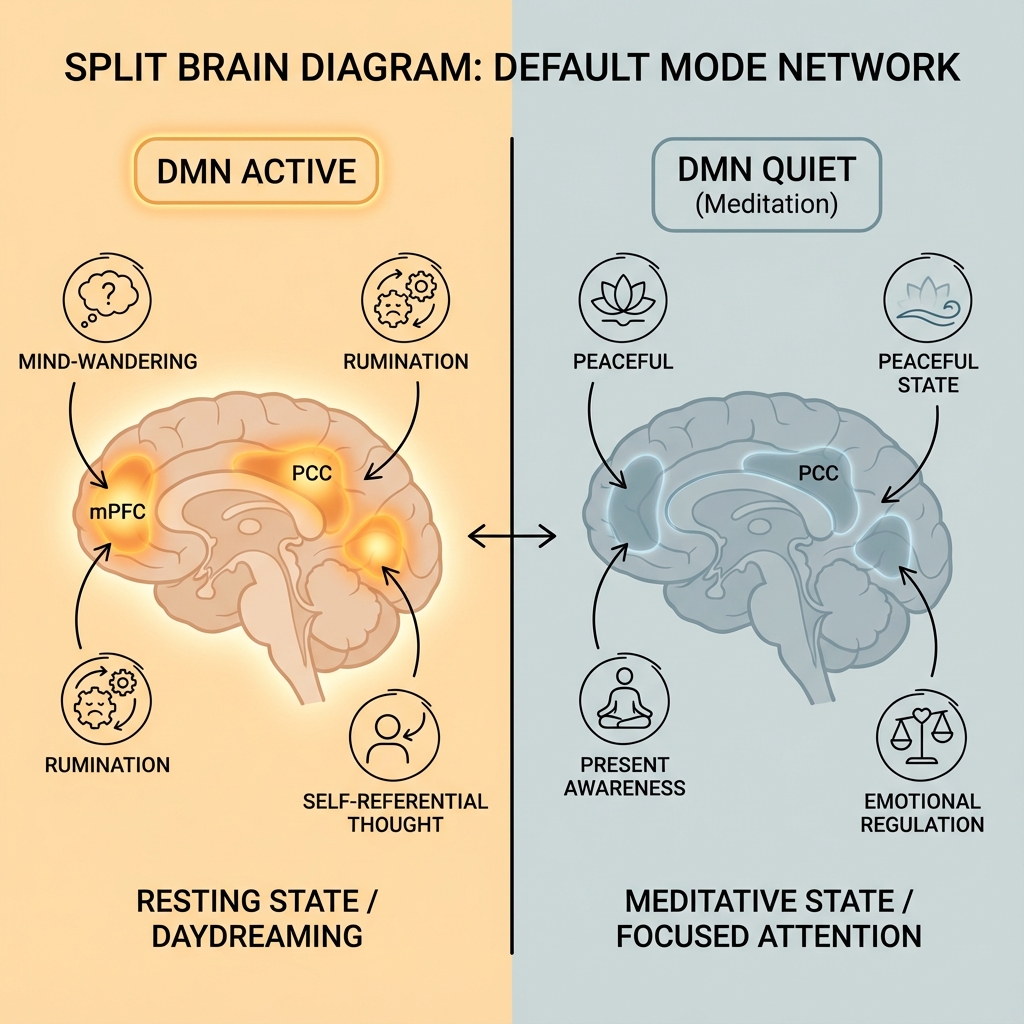
Key Brain Regions
The DMN includes:
- Medial prefrontal cortex (self-reflection)
- Posterior cingulate cortex (autobiographical memory)
- Angular gyrus (narrative and meaning-making)
- Lateral temporal cortex (conceptual knowledge)
The Problem with an Overactive DMN
An active DMN isn’t inherently bad—it enables creativity, planning, and social cognition. But:
Excessive Self-Focus
The DMN constantly generates “I” thoughts:
- What I did wrong
- What I should have said
- What might happen to me
- What they think of me
This can become exhausting.
Rumination
Depressed people show elevated DMN activity. The network gets “stuck” in negative self-referential loops.
Time Travel
The DMN pulls you out of the present. You’re physically here but mentally in past or future.
Effortful Rest
When your default activity is worry and self-criticism, “rest” doesn’t feel restful.
How Meditation Changes the DMN
Acute Deactivation
During meditation, DMN activity decreases:
- Focused attention meditation: Mind on breath, less wandering
- Open awareness: Watching thoughts without engaging
- Both reduce DMN activity compared to baseline
Chronic Changes
Long-term meditators show:
- Reduced baseline DMN activity
- Less DMN reactivity to stress
- Altered DMN connectivity patterns
- Faster return to low DMN after disturbance
The Notable Study
Researchers found that meditators not only reduced DMN activity while meditating but also showed lower DMN activity at rest. Their brains default differently.
What This Feels Like
During Meditation
- Fewer spontaneous thoughts
- Less mental narration
- More present-moment awareness
- Reduced sense of “self” as constant commentator
After Practice
- Less rumination throughout the day
- More able to focus without thought intrusion
- Greater contentment with present moment
- Reduced “time in your head”
Different Meditation Effects
Focused Attention
Concentrating on one object (breath, mantra) directly interrupts DMN with task-positive network activity.
Open Awareness
Witnessing thoughts without engaging prevents DMN patterns from completing and reinforcing.
Loving-Kindness
Activates different networks related to emotion and other-focus, shifting away from self-referential patterns.
The Self and the DMN
The DMN generates your sense of continuous self—the story of “me.” Reducing DMN activity:
Temporarily
During deep meditation, sense of separate self can diminish—experiences described across contemplative traditions.
Long-term
Regular meditators report less identification with the constant mental narrator. Less “I” thought, more open awareness.
This isn’t about losing yourself; it’s about not being trapped in constant self-referential commentary.
A Balanced Perspective
The DMN isn’t the enemy:
Valuable Functions
- Creativity and imagination
- Autobiographical memory
- Social cognition
- Planning and foresight
The Problem Is Dysregulation
Not activity itself, but:
- Can’t turn it off when you want to
- Stuck in negative self-referential loops
- Prevents present-moment engagement
The Goal
Not eliminating DMN function, but developing flexible control—able to engage or disengage as appropriate.
What This Means for Your Practice
Wandering Mind Is Normal
Mind-wandering is your DMN doing what it does. Noticing this and returning attention is the practise.
The Return Is the Rep
Each time you notice you’ve wandered and return to focus, you’re strengthening ability to disengage from DMN.
Patience Required
DMN patterns are well-established. Change takes time and consistent practise.
Progress Indicators
Noticing wandering earlier, returning more easily, less time “lost” in thought—these indicate change.
Frequently Asked Questions
Is DMN activity bad?
No—it enables valuable mental functions. Uncontrolled or excessive activity is the issue.
Can I measure my DMN activity?
Only with fMRI or similar brain imaging. Subjective experience (less rumination) is a practical indicator.
Why do beginners find meditation so hard?
Partly because DMN patterns are strong. With practise, the ability to disengage from default wandering improves.
Do all meditation types affect DMN?
Research suggests multiple types reduce DMN activity, through different mechanisms.
How long until my DMN changes?
Acute effects are immediate. Chronic changes develop over weeks and months of consistent practise.
The Bottom Line
The default mode network generates the continuous mental chatter many people want to quiet. It creates the endless self-referential narrative—past regrets, future worries, current judgments. Meditation directly addresses this network, reducing its activity during practise and over time changing its baseline patterns. Understanding this helps explain the “why” behind the “how”: meditation quiets your mind because it specifically targets the brain system that generates mental noise. The practise isn’t mystical; it’s applied neuroscience.