I remember reading about meditation brain studies and feeling sceptical.
“Meditation changes your brain!” sounded like marketing. Everything changes your brain — eating toast changes your brain. The question is whether the changes are meaningful.
After diving into the research, I’ve come away genuinely impressed. The brain changes from meditation are real, measurable, and relevant to how you actually feel and function.
Here’s what we know.
The brain is plastic
First, the foundation: your brain changes throughout life.
This is called neuroplasticity. The brain isn’t fixed after childhood — it continuously reorganises based on experience.
Repetitive activities strengthen certain neural pathways. Neglected pathways weaken. The brain you have reflects how you’ve used it.
This is why taxi drivers who navigate London streets show enlarged hippocampi (the memory/navigation region). It’s why musicians have thicker motor cortex in areas controlling their instrument-relevant fingers.
Meditation is a repetitive mental activity. If you practise regularly, predictable brain changes should follow.
And they do.
The key brain changes
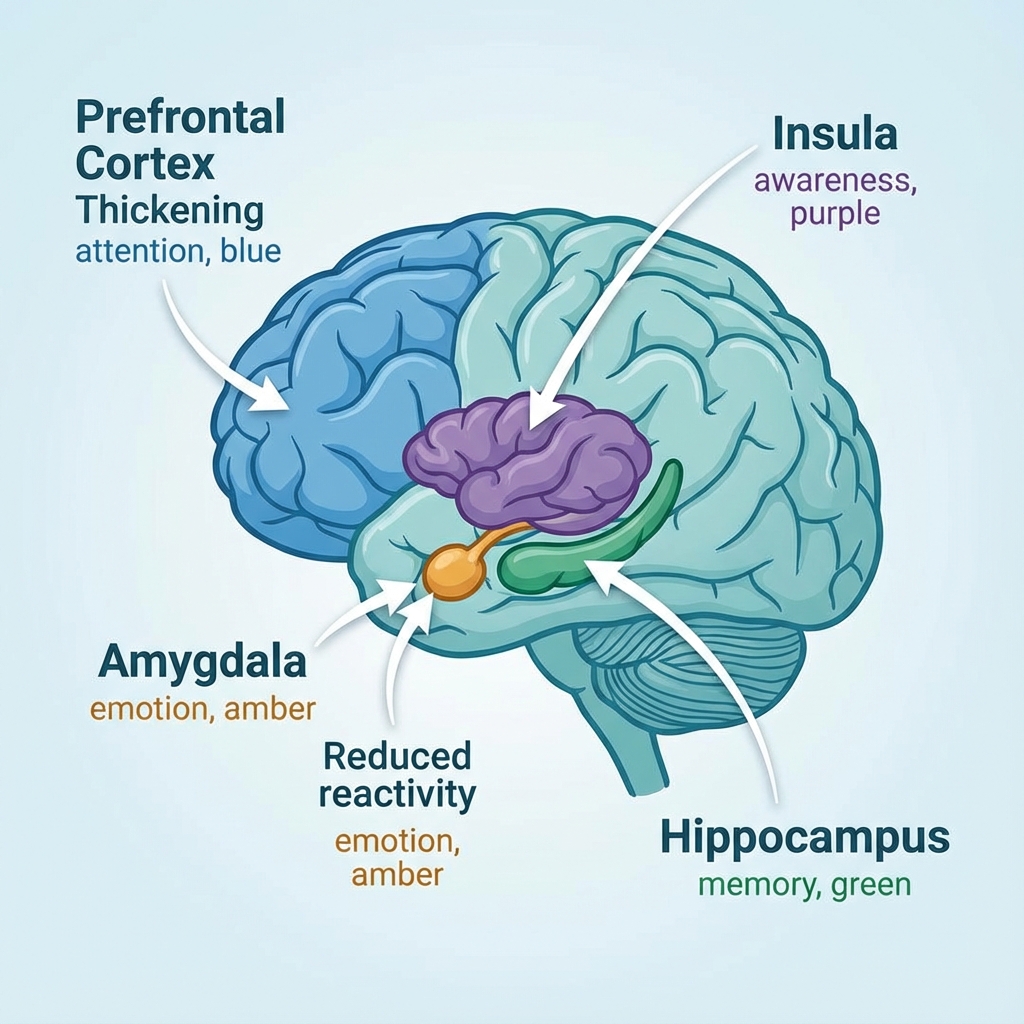
Prefrontal cortex
The prefrontal cortex (PFC) sits behind your forehead. It’s involved in:
- Executive function and decision-making
- Attention regulation
- Impulse control
- Planning and complex thought
Studies show meditators have increased grey matter density in the PFC. One well-known study by Sara Lazar at Harvard found that long-term meditators had thicker prefrontal cortices than non-meditators.
More impressively, novice meditators showed measurable PFC changes after just 8 weeks of practice (roughly 27 minutes daily).
What this means: improved capacity for focused attention, better impulse control, clearer thinking.
Amygdala
The amygdala is your brain’s alarm system. It detects threats and triggers fear responses.
An overactive amygdala contributes to anxiety. It fires at perceived threats that may not be genuine dangers — an angry email feels like a predator.
Research shows meditation reduces amygdala reactivity. Meditators’ amygdalae still respond to threats, but the response is less intense and recovers faster.
One study at Emory University found that 8 weeks of mindfulness training reduced amygdala activation in response to emotional images.
What this means: less reactive fear response, reduced anxiety, quicker recovery from stress.
Default mode network
The default mode network (DMN) is active when you’re not focused on external tasks — during daydreaming, self-reflection, and mind-wandering.
DMN activity correlates with rumination. When the DMN runs unchecked, you might spiral into self-referential thinking: worrying, replaying, planning, criticising yourself.
Meditation appears to reduce unnecessary DMN activity and improve the ability to disengage from it when you want to focus.
Experienced meditators show decreased DMN activity during meditation. More importantly, they show altered DMN activity even when not meditating — suggesting lasting changes to baseline mind-wandering.
What this means: less rumination, easier focus, less getting lost in unhelpful thought loops.
Insula
The insula processes interoception — awareness of internal body states. It helps you recognise hunger, heartbeat, emotional feelings in the body.
Meditators typically show increased insular thickness and activity.
What this means: better body awareness, earlier recognition of emotional states, improved emotional intelligence.
Hippocampus
The hippocampus is crucial for memory and learning.
Some studies show increased hippocampal grey matter in meditators. The research is less consistent than other areas, but trends point toward meditation supporting memory-relevant brain regions.
What this means: potentially improved memory and learning capacity.
How quickly does this happen?
The “8 weeks” figure appears frequently in research because that’s the standard length of MBSR (Mindfulness-Based Stress Reduction) programs.
Sara Lazar’s 2011 study found measurable grey matter changes after 8 weeks of practice averaging 27 minutes daily.
That’s about 25 hours of meditation practice total.
Some changes may happen faster. Acute changes in brain activation can be seen immediately during meditation. Structural changes — actual increases in grey matter — take longer.
The relationship appears dose-dependent. More practice, more change. But even modest practice produces detectable effects.
What the research doesn’t prove
While the science is encouraging, some caveats:
Correlation vs. causation. Many studies compare meditators to non-meditators. People who choose to meditate may differ from those who don’t in ways that also affect brain structure.
Randomised controlled trials (where non-meditators are assigned to meditate or not) address this somewhat. The Lazar study mentioned above was this type.
Individual variation. Not everyone shows the same changes. Brain plasticity varies. Some people may benefit more than others.
Mechanism details unclear. We know that certain changes occur, but how meditation produces them isn’t fully understood.
Long-term maintenance. What happens if you stop practising? Do changes persist? Research is limited here.
The science supports meditation, but claims should be proportionate. This isn’t magic — it’s brain plasticity responding to training.
What this means for your life
Beyond the neuroscience, what matters is function.
The brain changes correlate with life improvements:
- Reduced anxiety and depression symptoms
- Better focus and attention
- Improved emotional regulation
- Reduced reactivity to stress
- Better impulse control
These are measurable outcomes in research. And they match what most regular meditators report from subjective experience.
The brain changes aren’t ends in themselves. They’re the mechanism through which meditation produces its benefits.
Starting your own brain change
If you want to shape your brain toward calmer, more focused function:
Consistency matters. Regular practice matters more than occasional long sessions. Daily practice, even brief, creates the repeated activation that drives neuroplasticity.
8 weeks is reasonable. If you’re evaluating whether meditation works for you, commit to 8 weeks of regular practice before deciding. This is the timeframe where research shows measurable structural changes.
Any validated technique. The research covers various approaches — mindfulness, loving-kindness, Zen-style sitting. They all produce changes. Pick what resonates.
Be patient. You won’t feel dramatic shifts after a few sessions. The changes are gradual. Trust the process, focus on practicing, let the brain change happen in the background.
AI meditation and the research
The brain change research doesn’t specifically study AI-generated meditation. The studies typically use traditional guided meditation, apps like Headspace, or formal programs like MBSR.
At InTheMoment, the AI creates sessions based on validated meditation principles. Whether AI-generated or human-recorded, the core practices (breath focus, body awareness, non-judgmental attention) are the same.
What AI adds is personalisation. Sessions adapt to your current needs rather than offering generic content. Whether this improves outcomes compared to fixed content remains to be studied.
Two free sessions per day. The brain change happens through consistent practice — the AI is simply one way to support that practice.
The real story
Meditation changes your brain. The research is solid enough that major medical institutions now incorporate meditation into treatment programs.
But the brain science is really just an explanation for what meditators have experienced for thousands of years: regular practice changes how you feel and function.
The brain is the mechanism. The life improvement is the point.
Practise regularly. Be patient. Let your brain adapt to what you’re training it to do.
Ready to start changing your brain? Get started with two free sessions per day — consistent practice is what the research supports, and we’re here to help you maintain it.